From the city to safari

Monday was yet another moving day as we packed up in Johannesburg to head for Pilanesberg National Park. Kruger National Park is probably the most famous safari destination for Johannesburg visitors and it’s certainly considerably bigger than Pilanesberg, but we chose the latter for three reasons. First, it was recommended by a former work colleague (thanks, G-Mac) who has been here a number of times. Second, it’s a much shorter drive from Johannesburg than Kruger. And third, it’s in a malaria-free zone. Well, there’s a fourth reason: it was much cheaper.

I had booked our safari package back in late October and, between the couple of Pilanesberg accommodation options that had been recommended to me, I chose Kwa Maritane Bush Lodge. Booking is direct through the Pilanesberg website, but you need to pay the full amount in advance. I had used the splendid Revolut option to pay via a bank transfer in ZAR. Four nights dinner bed and breakfast plus one game drive for both of us each day cost GBP 1,100. In the context of prices I had seen quoted for safaris, that seemed remarkably competitive. So competitive, in fact, that I was a little worried about what the standard of the place would be.

I needn’t have concerned myself. The Lodge is beautiful, set just inside the park. We arrived here around noon and our room wasn’t quite ready. No problem. We had left Johannesburg without breakfast, planning to stop somewhere nice on the road. Sadly, the road seemed mostly free from quaint stop-off points, punctuated instead by occasional strip malls where MacDonalds appeared to be the primary option for travellers. We went to the hotel restaurant and grabbed a light lunch and, just as we were finishing, a porter arrived to inform us our room was ready. We completed formalities at reception and moved in.

When I booked all those weeks ago, I had been asked to reserve when we wanted our game drives, so I had booked the afternoon slot for today. We were to congregate at 4:15 to be allocated our trucks and departure was scheduled for 4:30pm. The process was very efficient and we settled ourselves in our allocated truck at the appointed time and waited to discover what we would see on our first ever safari experience.

OLYMPUS DIGITAL CAMERA

My advance reading on the topic had cautioned against expectation being too high. These drives can sometimes be disappointing. On this trip we saw….

Warthogs, Kudu, Impala, Eland, Zebra, White Rhinoceros, Elephants, Hippopotamus, Lions, Giraffes, Blue Wildebeest, Hyena, and Springbok. We were definitely NOT disappointed.

Here is a slideshow of a small selection of the photos from the drive…

This slideshow requires JavaScript.

We’ve managed to see three of the “Big Five” on our first day and we’re excited to find out what else we’ll see in our next three days here. Expect a lot more wildlife photography.


Another day in Melville

Here in Melville there’s a large area of public green space called the Melville Koppies.

DSC_0070

There are a couple of elevated points from which you can get a view across the whole of Johannesburg. Unfortunately, there are some security concerns with both the Western and Eastern Koppies which put us off going for a walk in them. Ishbel to the rescue! She did some online research and found that every second Sunday, there’s a guided walk in the Central Koppies – an area not generally open to the public.

The walk was scheduled for an 8:30am start and the meeting point was a 4 minute drive from us, so we arrived dead on time to join a group of around 20 people of all ages, from about 8 or 9 up to the leader, a gentleman comfortably in his 70s whose wife is the Chair of the committee that looks after the area. We split into two groups for the walk and spent an educational three hours walking round the Koppies and admiring the views of Johannesburg available from there.

IMG_2988 (1)We learned about the first known homo sapiens occupants of the Johannesburg area, the San bushmen, who are known to have been here about 90,000 years ago. The San lived in social groups and were subsistence hunter gatherers. The arrival of Bantu peoples in the region from about 1,500 years ago, with their advanced metalworking technologies and agriculture led to the San gradually being outcompeted and/or subsumed through inter-marriage into the Bantu culture, which was the dominant population until the arrival of the Dutch colonists in the 17th century and, with them, gunpowder and firearms.

Over the three hours of walking we covered less than three miles, but we were still fairly wiped out by the end thanks to the high temperatures. The first thing to do after we got back was to shower and change.

Monday was another moving day for us, so we started prepping some of our packing later in the day on Sunday then headed back up to 7th Street for an early dinner. Again, we took a somewhat indecisive stroll along the street, looking at the various menus that were available. We eventually decided on Hell’s Kitchen largely because as we walked past, they were playing our song. “How romantic,” you’re thinking. Our song is “Sheena is a Punk Rocker” by The Ramones. This is because when we were at Glasgow University, but before we started going out together, most women chose not to dance with me to this song as my friends and I would go nuts, pogoing all over the place. Ishbel, bless her, always indulged me and agreed to dance when asked. She was a keeper even then.

Anyway, Hell’s Kitchen was the dinner choice and we both had Skillet Fillet, which is a fillet stuffed with feta, basil and chili paste in a jalapeno sauce. Really tasty. Also, the music they played in here lived up to the promise of the Ramones track that drew us in. And, they’re delivering festive greetings…

IMG_2990

I had a couple of pints of their very tasty Devil’s Peak IPA with dinner and then we headed home. We got back to the apartment about 15 minutes before Johannesburg was, once again, drenched by a huge thunderstorm.

Hanging out in Melville

One of the reasons we selected this particular AirBnB was its location in Melville. I had read that this was the happening, Boho area of Johannesburg. Given that we had arrived in the city with little by way of concrete plans, it was surprising to realise that we had been so busy that we hadn’t yet spent much time locally. We decided to fix that on Saturday.

Earlier in the week, we ate in a little Italian restaurant, Cafe Picobella just a couple of blocks away in 4th Avenue at 5th Street but we had previously driven down 7th Street which is the hub of Melville’s restaurant and bar area. We decided that we would start the day with brunch there.

After the overnight storms, the day had dawned bright, clear and hot. We walked up to 7th Street and strolled up and down to see what grabbed our attention before settling on Bread and Roses where I enjoyed an omelette with smoked salmon and cream cheese and Ishbel went for the steak and eggs.

IMG_0698 2The restaurants attract a lot of people from all over Johannesburg, not just the locals. The influx of people inevitably attracts street vendors as well. Our eye was caught by these ladies selling baskets.

IMG_0693 2After brunch, we had a short wander but the temperature was already up in the 30s, so we headed back to relax at the apartment. We’re pretty much down to two meals a day at the moment, and that’s particularly true after such a large breakfast so we took some time to review our Soweto photos from the previous day, had some communications with friends and family back home, and played our instruments for a while.
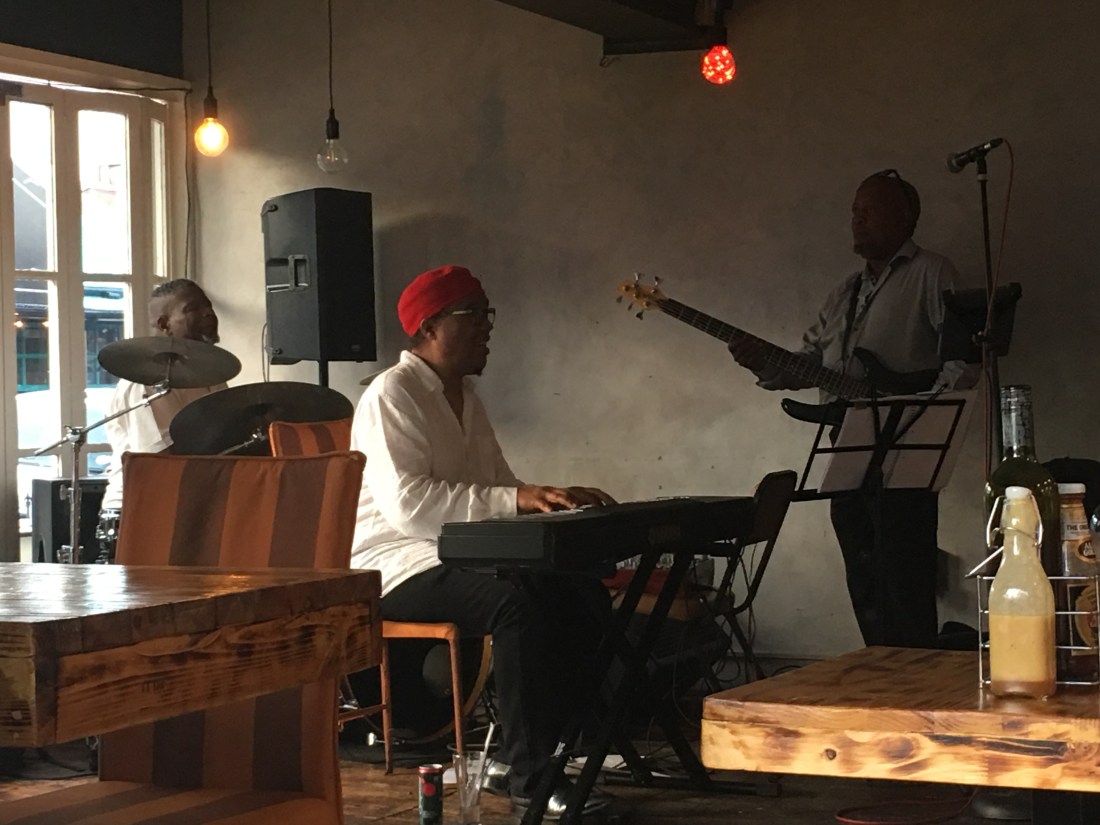
In the early evening, we decided we would venture out again to find a dinner venue. Again we strolled up 7th Street but we were sold on Poppy’s by the sound of cool jazz music floating out of it. We managed to grab a pavement table that allowed us to hear the music and see the band.

IMG_2982 It turns out that these three cats had all played in Hugh Masakela‘s band. Masakela was known as the father of South African jazz and built a global reputation as a musician. When he was a young man playing jazz in South Africa, Louis Armstrong sent him one of his own trumpets as a gift. He died at the start of 2018, but Ishbel and I were lucky enough to have seen him play in Brighton a few years ago. He was wonderful. As you can imagine, stumbling across musicians of this quality in a neighborhood restaurant in Johannesburg was a rare and unexpected treat for us.

We enjoyed our meals accompanied by a couple of pints of Soweto Gold then, after the band had finished, made our way home at the end of our most laid-back day of the trip so far.

One Day in Soweto

We booked our first ever AirBnB Experience for Friday. It was called One Day in Soweto and was hosted by Sipho. If you recall, we had already met one Sipho in South Africa: our guide for our tour of Robben Island jail. This time, Sipho was younger.

We had arranged to meet at the Hector Pietersen museum and memorial. Sipho recognised us as soon as we parked the car and reassured us that someone would look after it until we got back. Another couple was joining us on the tour and they arrived dead on time for the noon start. Sipho started with an explanation of the circumstances of Hector Pietersen’s death, but then put the story into the context of the unchanged geography of the place where we were standing and walked us along to the point where Hector was actually shot, and where the first of an avenue of commemorative olive trees was planted by Nelson Mandela. We then walked down Vilakazi St, the street of two Nobel Prize winners. Nelson Mandela’s house is now a museum, but Desmond Tutu’s daughter still lives in the same house her father occupied.

IMG_2957 At the end of Vilakazi St we climbed a small hill at the back of the houses which gave us an extensive view over Orlando West, which is the part of Soweto we were in, and Orlando East, which was our next stop.

IMG_0629

We walked down and crossed the busy main road which divides the two Orlandos, named for Johannesburg’s mayor of 1925-6, Edwin Orlando Leake. As we crossed the main road, we spotted the commercial signwriters at work in the picture at the top of the page. There seems to be less graffiti in Soweto because blank concrete space is rented out for local businesses to paint advertising signs on. We then strolled uphill to our lunch spot: Nkukhu Box. Ishbel had chicken and pap with hot sauce, and I had a hot kota:

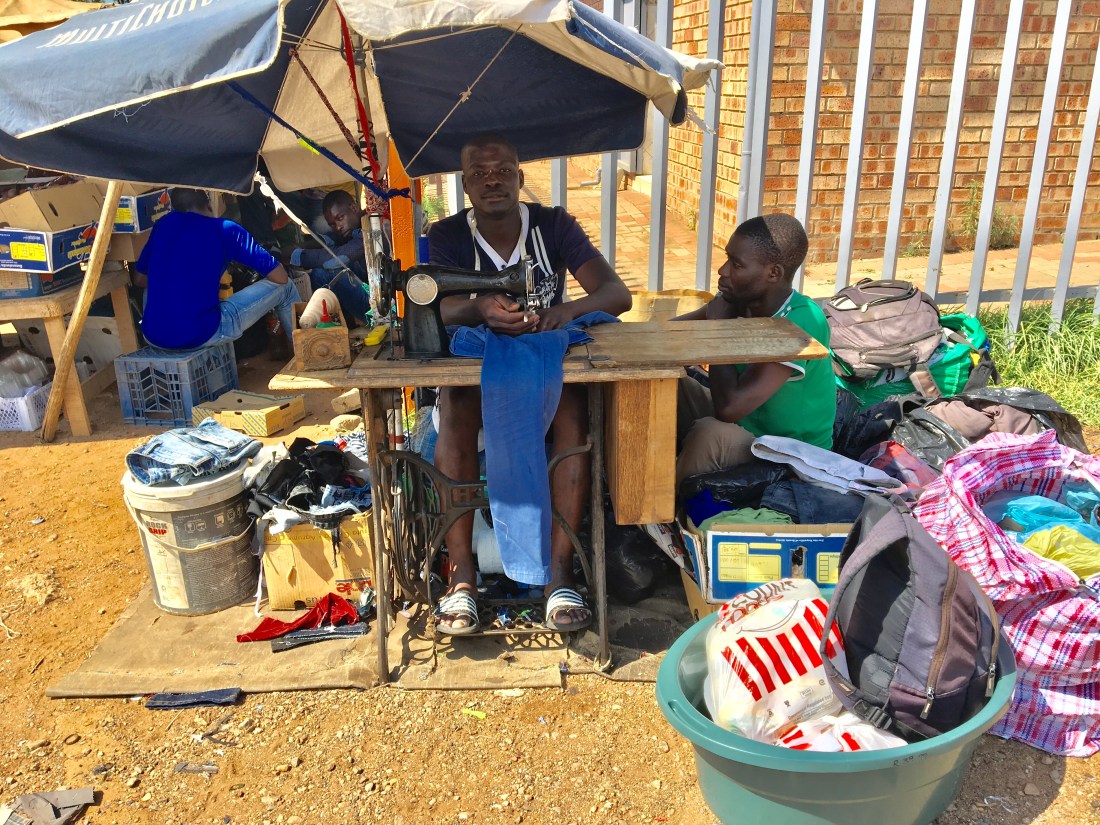
IMG_2963After lunch we continued our stroll. There are a lot of streetside vendors of both goods and services and we were particularly taken by this gentleman offering clothing repairs and alterations on the verge at a busy junction.
IMG_0656We tipped as we went for photos that we took. Sipho pointed out to us that, because of the areas we were visiting, locals were pleased to see tourists making the effort to visit. In fact, at one point, someone approached Sipho and asked if he could get his photo taken with Ishbel and me. He produced his mobile phone, handed it to Sipho, and put his arms around us. We all three grinned broadly and he went off happy with his snapshot of old white Sowetan tourists.

We continued our walk to the Orlando Stadium, home of the Orlando Pirates and the place where Nelson Mandela addressed the people of Soweto shortly after his release from captivity.

OLYMPUS DIGITAL CAMERAOrlando East is the home of the Orlando Pirates. Orlando West is the home of the Kaizer Chiefs – a football club long before they were a band.
From the stadium, it was time for a break from walking. For our next leg of the tour, we were taking a minibus taxi. These things are ubiquitous in South Africa and are used as a cost efficient way of getting from A to B. At least, they’re used by people who understand how the system works. There are a range of hand signals whereby you indicate where you want to go and the driver indicates where he is headed. You actually need to know in which direction your destination lies before you can even contemplate this. Luckily, Sipho knew that the relevant signal for us was pointing straight back over your shoulder, so we got the right minibus. This took us up to Bara, the area around the Chris Hani Baragwanath Hospital, the third largest hospital in the world.

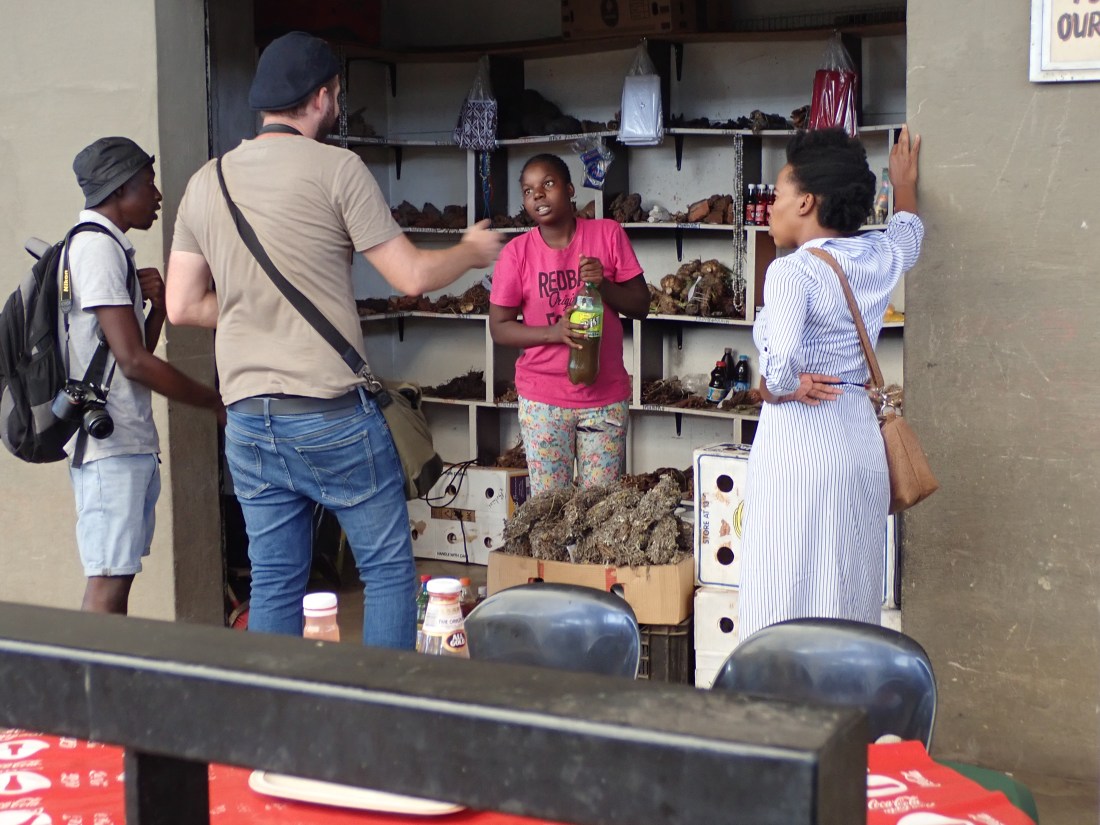
It is also home to a frenetic market and what is probably the largest minibus taxi rank in the world. The couple who were with us on the tour decided to have an interesting chat with one of the vendors: a doctor of traditional African medicine. Declining the opportunity to acquire a potion that will provide a man with all-night vigour, they eventually bought some herbs which can be burnt together with chicken blood to enable communication with one’s ancestors. He was a robust Norwegian chap, so I’m not sure how his Viking ancestors would react to being summoned in such a way.

OLYMPUS DIGITAL CAMERAFrom the market, we continued our stroll heading down towards the Soweto Towers, the decommissioned chimneys of the Orlando Power Station which now act as giant advertising banners as well as a bungee jumping hotspot.

OLYMPUS DIGITAL CAMERA

More importantly by this stage of the day, there is a bar at the base of the towers. We all welcomed a cold beer as we had walked a fair distance by this time and the day had been blisteringly hot. We could see some storm clouds in the distance but they didn’t trouble us as we relaxed over our drinks.

IMG_2977 (1)

After quenching our thirst, it was a walk back up to Bara to the rush hour frenzy of the minibus taxis going everywhere across the city – and beyond. There were minibuses, with luggage trailers, headed for Zimbabwe and Lesotho among other places. We managed to get on the second taxi to arrive and went back to the start point at the museum. Although advertised as a four and a half hour experience, we had been on the go for a full six hours. And we had loved every single minute of it.

Sipho has an insta account that you could check out if you want to see more of what he does. I’d recommend it, and I’d recommend his tour if you find yourself in this part of the world.

All that remained for us was the easy drive home. Except, remember those storm clouds I mentioned earlier? About halfway home, I heard a loud clunk on the roof of the car. Followed by several thousand more. We got caught driving in an outrageous summer hailstorm. We tried to follow the example of a number of other cars and pull onto the verge under the shelter of the trees. Except I somehow contrived to miss the trees entirely. I decided it was abating after a couple of minutes and got back on the road. It had turned out that the other couple on the tour were staying at an AirBnB just along the road from us so we had driven them back to their place before heading home and parking up for the night. The thunder and lightning continued throughout the entire night.

A delve into the dark past

On Thursday, we decided we would visit the Apartheid Museum, so we had a gentle start to the day before driving across Johannesburg to get there. Interestingly, the museum came into being as a result of the process for granting casino licenses. To be awarded a license, bidders had to demonstrate how they would improve tourism and the local economy, which is why the museum neighbours a casino.

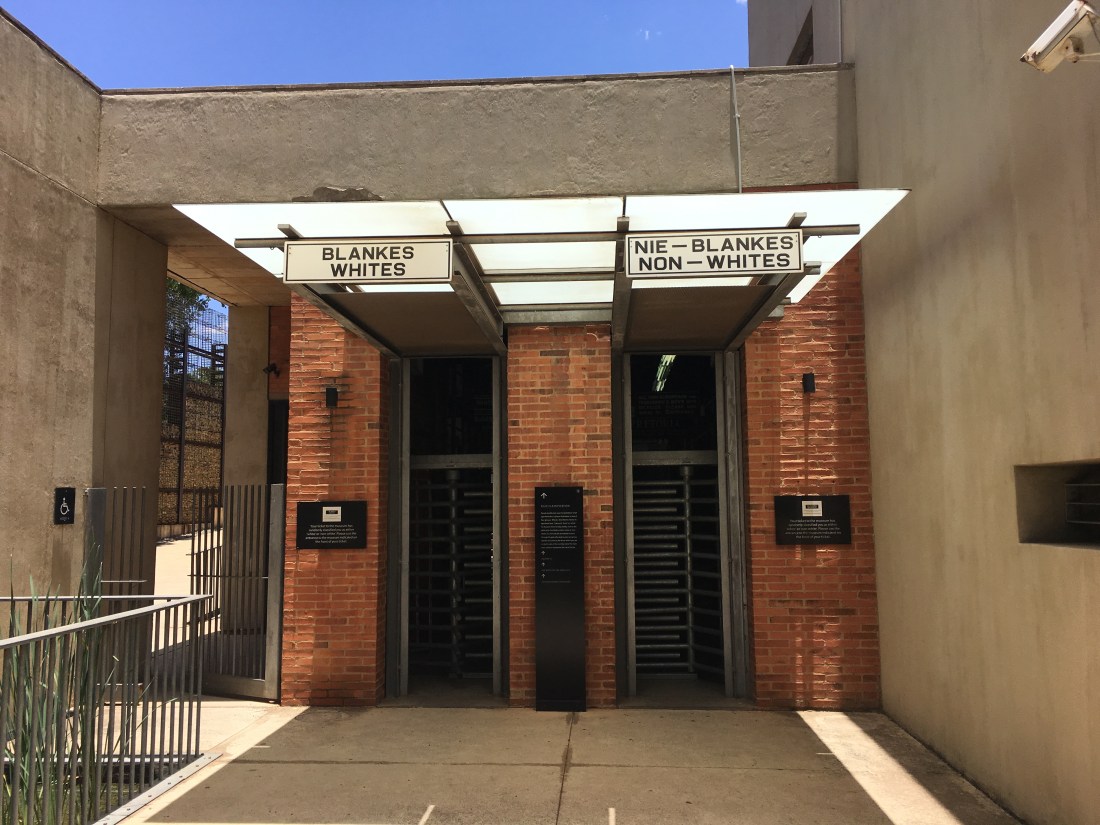
The first sense you get of the impact of apartheid is at the ticket office, when you are handed these tickets…

IMG_0593…and you’re forced to use separate entrances to the building. As you pass through the opening exhibition, you are bombarded by an astonishing array of signs designed to keep the races apart. The sheer volume of signage required is actually a demonstration of just how artificial the segregation policy was.
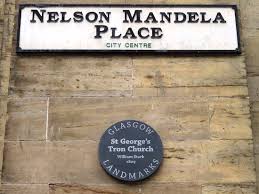
When we got to the museum proper, the first thing we encountered was a temporary exhibition on the life of Nelson Mandela. This was very interesting and covered everything from his being named Rolihlahla at birth to being given the name Nelson by his teacher on his first day of school, through his growing political awareness and founding of the ANC youth wing, all the way up to his inauguration as president. As a Glaswegian, I have always regarded it as a matter of civic pride that we were one of the first places in the world to name a street in his honour.

nmpMandela was awarded the freedom of the city in 1981 and the following year Glasgow’s mayor launched a global petition for his release from prison which was ultimately signed by 2,500 city mayors worldwide. In 1986, St. George’s Place was renamed Nelson Mandela Place. Largely because it was the postal address of the South African High Commission in the city.

After the Mandela exhibition, we went to the main apartheid exhibition, which didn’t pull any punches. Although apartheid was officially implemented by the National Party government elected in 1948, the seeds of the policy had been sown much earlier through the housing policies that existed for, in particular, native africans who had migrated to the cities in search of, usually manual, employment in heavy industry. Segregation was strictly enforced through an ever expanding set of legislation which began with the pass laws. Everyone was classified according to what an assessor determined their race was, but appeals were possible…

IMG_0595The growth of the black political consciousness in response to these unjust laws and the absence of the vote, led to the creation of political movements, most famously the African National Congress. The ANC was promptly banned by the South African government and it became a crime to be a member.

Apart from an examination of the roots of apartheid, there were also various videos of newsreels from the various periods. The one I remember from my youth was the Soweto Uprising when schoolchildren began protesting at the government’s decision to start teaching many subjects in Afrikaans, regardless of what the teaching language had been previously. This had the effect of stunting the studies of many bright and capable students. Much as if the British government decided it would start delivering lessons in French. Police fired tear gas at the schoolkids and, when they did not disperse, started firing live rounds into the crowd. There’s an iconic photograph from that first day of protests that shows a young man carrying the body of a 13 year old boy, Hector Pietersen,  accompanied by his sister.

Hector_pietersonAs a schoolboy myself at the time, I couldn’t imagine the terror these kids were facing, And it continued for another 15 years.

The exhibition overall is extremely powerful and, I would think, a must-see if you are going to put South Africa in context. Particularly moving was the last video room, where they show actual footage of victims’ families confronting their relatives’ murderers. It’s both riveting and chilling. The museum says they expect a visit to take between one and a half and three hours. We spent four and a half hours there.

Cradle of Humankind

Wednesday was our first full day in Johannesburg. We have a fairly short list of things to do here so we’re going to be playing it by ear somewhat. One thing we had come across in our research was the Sterkfontein Cave Complex, and the Cradle of Humankind Museum at Maropeng. Google Maps advised it was a 45 minute drive away so we decided to give it a try.

We went to the caves first as the website advised it got busier as the day wore on, and arrived there in time for the 11am tour. Ishbel was absolutely delighted to get her first ever experience of a discount for seniors. Now that she’s over 60, she qualifies. She was even more delighted when the lady in the ticket office assumed I would also be entitled and I had to vigorously defend my youthful right to pay full whack. My boyish good looks may well be on the wane.

Everyone on the tour as issued with a hairnet, to prevent transfer of hair-dwelling bugs, and a crash helmet. It felt like overkill, but I was glad of it the couple of times my head bumped against the roof. There was a long staircase to descend into the caves and a reasonable full size walk for most of the way. Towards the end, there was a section that required quite a bit of stooping and some crawling, so the warnings at the start about claustrophobia should be taken seriously. We were glad to get to the end and the upward section back to the surface.

IMG_2933There have been quite a number of hominid fossils discovered in the caves over the years, and our guide was very knowledgeable in discussing both the palaeontology and geology of the area. I assumed he must have had a geology degree, but he didn’t. Very impressive.
After the caves, we went to Maropeng where they have an excellent exhibition on a recent (2013) archaeology/palaeontology dig where they found bones of 15 individuals from a hitherto unknown hominid species. They also had a display of the various hominids that have been known to exist over geological time. Well worth seeing.


After completing our tour, we had a cold drink. Temperature was in the 30s, so we were feeling the heat. Thereafter, we headed back to our apartment in Jozi, which I believe is the locals’ preferred abbreviation rather than Joburg. Ishbel has been navigating on this trip and has been doing a pretty good job, despite the sometimes difficult to follow road signage we’ve encountered. We decided to come back via 7th Street here in Melville, which seems to be the restaurant hub for the area. It certainly looked like wall to wall restaurants as we drove down it. We decided for tonight to start slow and take the easy walk to an Italian restaurant in 4th avenue, which is only three blocks away. We had a nice pizza – thin crust is the preferred base over here. Afterwards, we had a nightcap in a Mexican bar/restaurant just along the road from there before calling it a night.

Wine and Flights

Monday was our last full day in Franschhoek and we had already booked our driver from Thursday and Friday night (Hannes) to take us on a tour of wineries for the day, finishing with a late lunch at Roca, the restaurant in the Dieu Donne vineyard. I’m not sure how your Monday mornings are shaping up these days, but if it’s better than this one, I’d be surprised.

We set off at 10:30 and headed out of town on the road towards Stellenbosch and Paarl to visit Vrede en Lust vineyard. The tasting they offered us was a remarkable 6 wines for ZAR 50 per head. One thing that comes as a constant surprise is the opportunity to sit outside, drinking wine in the warm summer sunshine, and admiring the Christmas decorations. Jarring. But pleasant.

IMG_0437

We took our time enjoying the three whites and three reds they provided then headed back to the car. When I say we took our time, I was surprised to find that we had been there for an hour and a half.

Next stop was intended to be Rupert and Rothschild, but it was closed. Hannes knew I was fond of the occasional beer, so he offered to take us to a winery that had both wine and beer. And chocolate. The Spice Route farm near Paarl has a number of different tasting experiences available but, in the end, we plumped for a dozen different amazing chocolates for ZAR 20 per head, and went straight on to the five wines for ZAR 40 per head. We burned up another hour here, so we were running out of time to do anything else. Nevertheless, we squeezed in a quick visit to Fairview. We felt we had already managed a lot of wine at our stops so far, but we hadn’t had any cheese! Fairview is a renowned South African cheese maker and, despite the splendid wines on offer elsewhere, this was by far the busiest venue we visited today.

IMG_0456

We paid ZAR 20 to enjoy 6 cheeses, each of which was excellent but the standout was the garlic goats cheese. We bought a small amount of that in case we decided on a late supper that evening after our lunch.

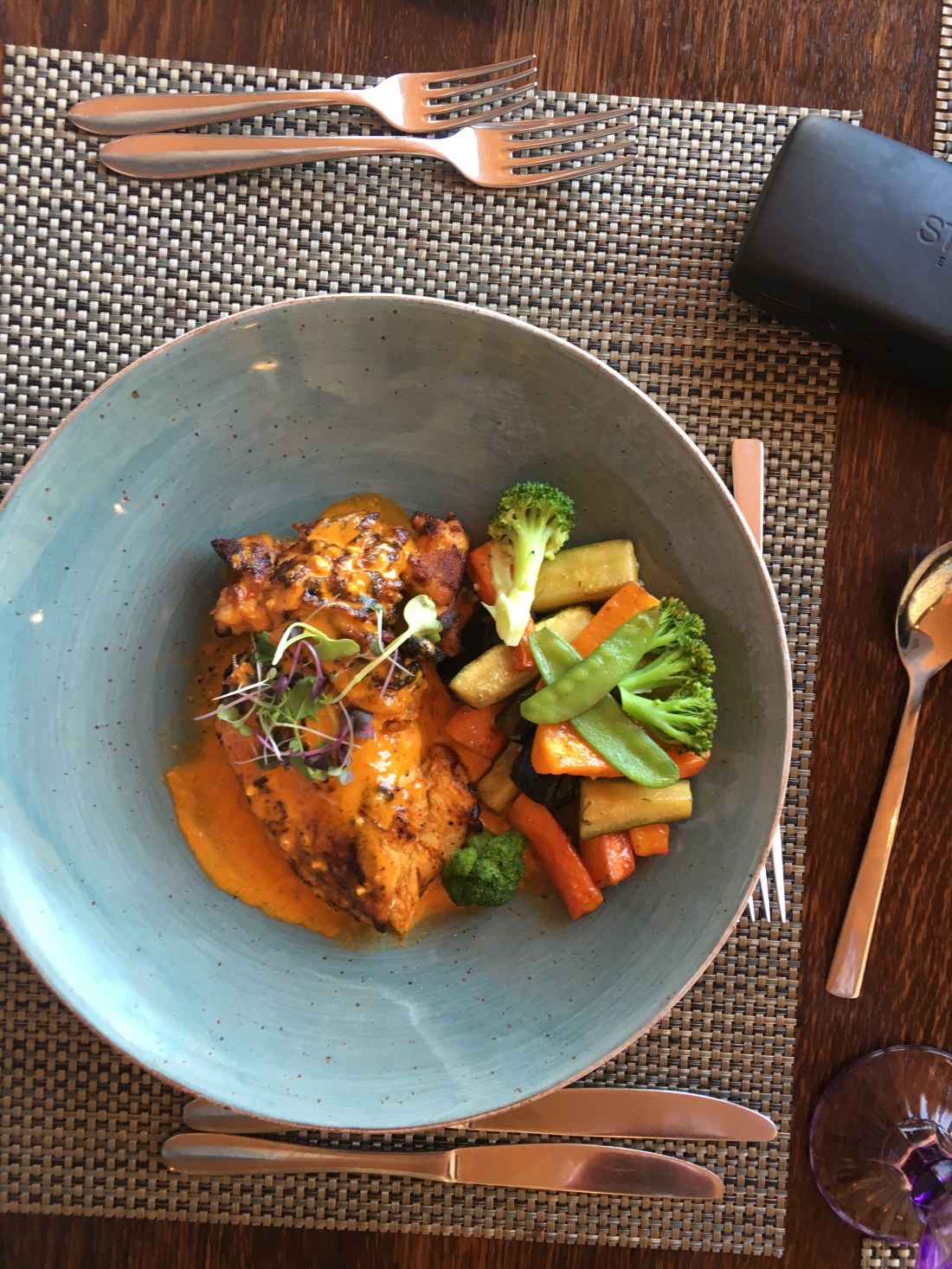
On to Roca, where we enjoyed an excellent lunch and where, I think, we redeemed ourselves for the instagram generation. I had free range, deboned, Mozambican chicken with roasted vegetables, peri-peri sauce, and hand-cut chips.

IMG_2920 2

Ishbel went adventurous and had a medium ostrich fillet with pommes puree, young vegetables and a creamy peppercorn sauce.

IMG_0460

To follow, Ishbel had the vanilla creme brulee with wild berry puree and strawberry sorbet and I went for the cheese board.

Also, if you remember how I raved about the Chocolate Block wine when we arrived in Franschhoek last Thursday, I’m delighted to have ticked that particular box at Monday’s lunch.

IMG_2918

I was so delighted, I even sent a gloating Whatsapp to friends back home, which was unworthy of me. Sorry Dims.

After lunch, we drifted back to the hotel in a stupor and made a half-hearted attempt at packing for the following day’s flight. Our Johannesburg flight was leaving Cape Town at 12:20, so we needed to get a reasonably early start on the one hour drive, but it wasn’t a desperate rush. What we did find was that, once again, BA decided we had too many flights on our booking to allow us to check in online. This feels like a fundamental flaw in how they market and sell round-the-world tickets. But I’m still not paying an extra 70 quid a head to book a seat.

Anyway, as Tuesday dawned, we had an early breakfast and headed to the airport to return our Toyota Corolla, which had served us well, and check in for the flight. It all turned out well enough and we were in 2E and 2F. Not what I’d have chosen if I’d had access to the seat selections earlier, but at least we were next to each other.

The flight was uneventful, and we arrived in Johannesburg on time. We made our way over to Avis, which is much closer than at Cape Town, but really badly signposted. They try to make you go down and up in an escalator to bypass the airport road, but since we had trolleys, this was impossible. Eventually, we just went straight out the front door and across the road, which was nice and easy.

As with Cape Town, we had booked a small car and, as with Cape Town, they upgraded us. This time to a Nissan Almera. If you intend travelling like this, it is definitely worthwhile joining the Avis Preferred, or whatever loyalty program is offered by your preferred renter. It definitely makes a difference, both in length of queue and type of car.

Anyway, we picked up the car very easily. I had also rented a mobile hotspot from them, We don’t have free data access here, so this is a cost efficient way of accessing the net and using phones as SatNav solutions. This got us to our AirBnB in Melville, Johannesburg in a fairly straightforward fashion. We settled in and did a quick grocery shopping. Thanks to the business class on the plane, we had enjoyed a substantial lunch so we got some cold meats for a light supper plus, of course, the wherewithal for a pot of tea.

We’re two flights in to the journey and now the Johannesburg adventure starts. Keep checking in for the updates.


A hike and a beer

Sunday dawned brighter and warmer than the previous couple of days. Importantly, we could see the peaks surrounding the valley unshrouded by cloud. This meant our plan to postpone our hike at Mont Rochelle Nature Reserve from Friday until today was a good one. Temperature at the valley floor after breakfast was around 23°C but it had dropped at least 5° by the time we reached the top of our hike. We walked the Vista trail which is only about 2.5km, but has an elevation change of 275m, so it’s a brisk climb but worth it for the views, illustrated in the picture above.

After the walk, we headed back to the hotel to freshen up before a late lunch. We found the previous day that, between the substantial breakfast omelettes and the late lunch, we weren’t in any mood for dinner. We’ve been having only two meals a day most of the time we’ve been on the road, but usually breakfast and dinner. Breakfast and lunch seems to be equally adequate.

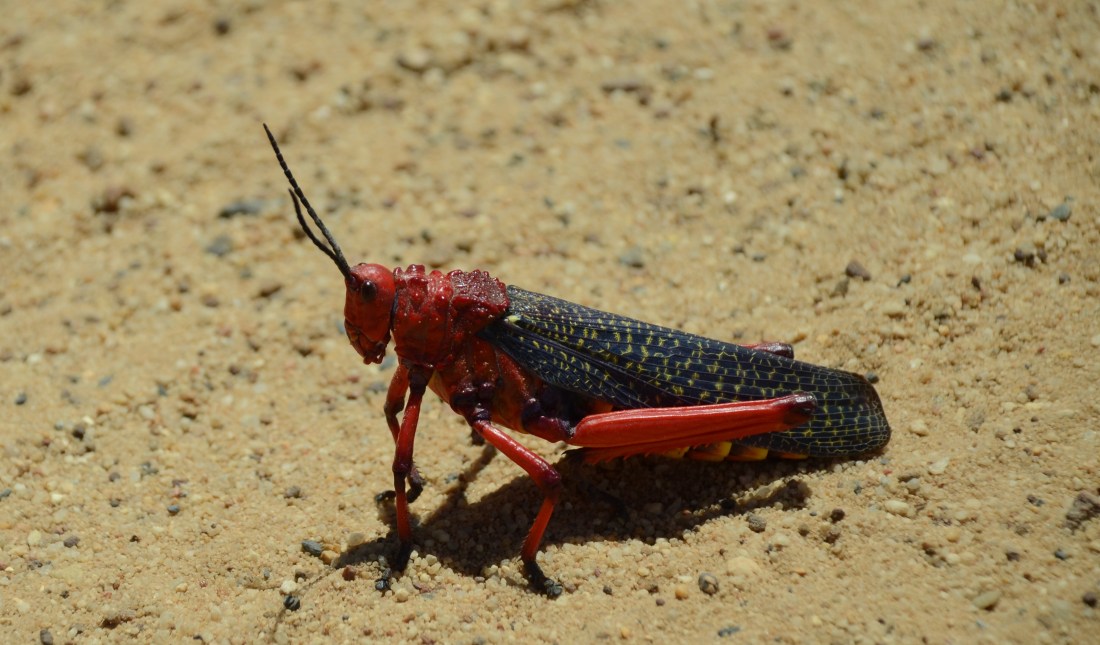
As we turned up the farm road that leads to our hotel, I noticed something in the road that, ridiculous as it seems, looked like a cooked prawn. Until it scampered across the road a little. Then it looked like a scampering cooked prawn. Until it took to the air, and became a flying cooked prawn. Ishbel managed a close up photo of it so it looked less prawn-like in HD.

DSC_0129 Despite its obvious red colour, this beast is called the Green Milkwood Locust.
After a much needed shower, we headed back into town for lunch at the Tuk Tuk Microbrewery. We had stopped in here on Thursday night for a beer and I had enjoyed their Pale Ale so much that we decided to head back there for a refreshing pint and some lunch.

IMG_0420

Lunch was simple but pleasant enough fare: burrito for Ishbel and quesadilla for me. One thing we noticed as we sat on the terrace was the vast number of motor bikes that came through town in the afternoon and early evening. The road over the pass is hugely popular with recreational bikers and the town is filled with them every weekend.

Cycling and cheetahs and wine, oh my

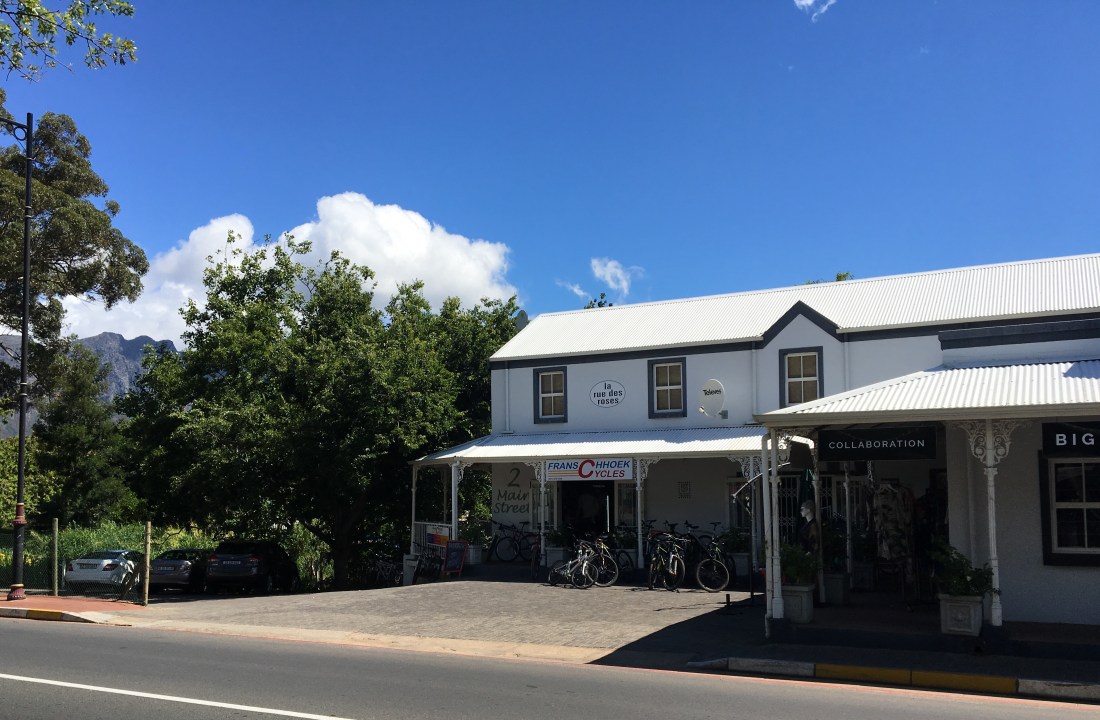
It would be easy to laze around on a trip like this and become increasingly indolent. If you weren’t travelling with Ishbel, that is. So it was that, for Saturday we agreed that we would do a tour of some of the wineries for which Franschhoek is justifiably famous. To get round those wineries closest to town, we decided to rent a couple of bicycles. After picking up our laundry at the appointed time, we made our way along to Franschhoek Cycles, where we had arranged our rentals the previous day. We were supplied with a carefully annotated map, a couple of helmets and, of course, a bike each.

Off we set along the mostly flat main road to our first target: Grande Provence. The driveway up to the main estate buildings is picturesque, rolling through the vineyards that provide the harvest for their wines. Their buildings include a large art gallery but also something of a surprise: a cheetah sanctuary. As we arrived and saw the signs, it was obvious that we would be seeing the cheetahs before anything else.

At the Cheetah Outreach Centre, they also offer what they call ”encounters” where you can enter the enclosure and get up close to an animal. This held no attraction for me but Ishbel liked the sound of it. 

IMG_0351.jpg

The outreach centre takes in animals from captive breeding programs and supports the maintenance of a DNA database that identifies breeding opportunities to maintain a diverse gene pool.

After that, we deserved a wine tasting and duly partook of three of the vineyard’s finest tipples.  Once that was done, it was back on the bikes and a quick 5km back through town and out the other side to La Bri estate. La Bri offers some interesting pairings, so we each tried a different one. Ishbel had three wines paired with Turkish Delight and I had three paired with chocolate. Very nice.

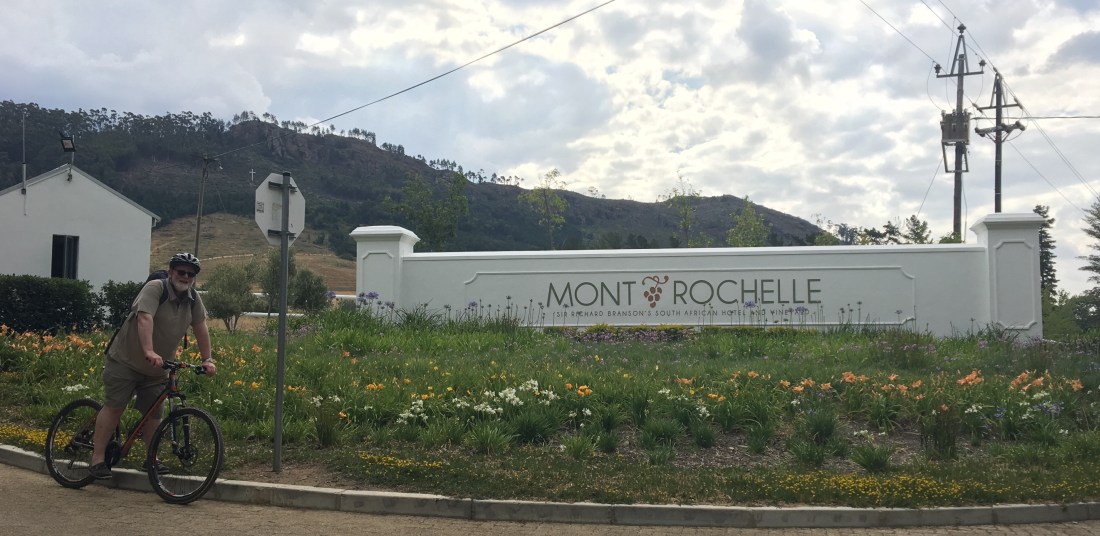
Just a short ride back towards town and we stopped at La Couronne. We only had a two wine tasting here as we still had to get all the way back through town again as we had decided that we liked the look of Mont Rochelle for lunch. Mont Rochelle is a vineyard and hotel owned by Richard Branson. How do I know this? He doesn’t exactly make a secret of it…

IMG_0383

We decided we were somewhat underdressed for the gourmet restaurant on the estate but had a very nice lunch on the terrace of Country Kitchen, their more casual option. Interestingly, this is the first place in South Africa where we had access to free wi-fi without actually being a paying guest. It’s odd when something that you now take for granted at home becomes a bit of a luxury.

After lunch, we decided we should hand back the bikes while we were still sober, and headed back to relax at the hotel.

A stroll through Franschhoek’s history

I had awoken during the night to the sound of heavy rainfall outside so it was no surprise to find that Friday morning was overcast and drizzly as we made our way to the breakfast room at our hotel. While the temperature may have been a little cool, I’m not convinced it justified the roaring log fire at breakfast. We took a table as far away from it as possible and enjoyed our omelettes and multiple pots of tea.

We had intended driving back up Franschhoek pass to Mont Rochelle Nature Reserve to hike one of their trails, but looking up from the floor of the valley, we could see the surrounding peaks swathed in cloud. Weather is due to improve steadily, so we decided to postpone that activity till Sunday, leaving us at a loose end for the day.

It’s important to be pragmatic when travelling for eight months with a single suitcase. Any opportunity for laundry should be leapt upon, and Franschhoek has La Laundry which offers service washes, so we decided to try to locate that. We ended up parking at the wrong end of town, so had to walk all the way through to find it. Then all the way back to the car. Once we got there, we decided we should visit the local museum, which includes the Huguenot monument (pictured above) and where we became considerably better educated on the history of this area.

Franschhoek used to be called Olifants Hoek, or Elephant’s Corner, because cow elephants used to make their way over the surrounding mountains to calf in the protected valley. Early white settlers arrived here in the 17th century and recognised the agriculture opportunities afforded by the fertile valley floor.

In France, at the same time, protestants were being persecuted and denied their right to worship. These French protestants were known as Huguenots. As a result of continuous persecution, many fled France forefeiting all property and possessions. A number of those refugees arrived in the Netherlands, where their faith was supported but where they encountered severe economic hardship. Much like religious and economic refugees of today, really. So it was that, when the representative of the Dutch East India Company here in South Africa pleaded for more settlers to farm these lands and deliver provisions to the Company’s ships, the settlers that were delivered were, ultimately, around 300 Huguenots. Those Huguenots who settled in Elephant’s Corner and began farming here retained their native language for a considerable period of time. Thus the area came to be known as French Corner, or Franschhoek. And, of course, the French included vines in their planting so the Franschhoek wine industry was born.

That was quite enough history for one day, so we made our way off to one of the places recommended by our hotel, Babylonstoren, a vineyard with a lovely garden. We had a stroll through the garden and Ishbel encountered the wild animal she’d been itching to see since we got here: a tortoise.

DSC_0093.JPG

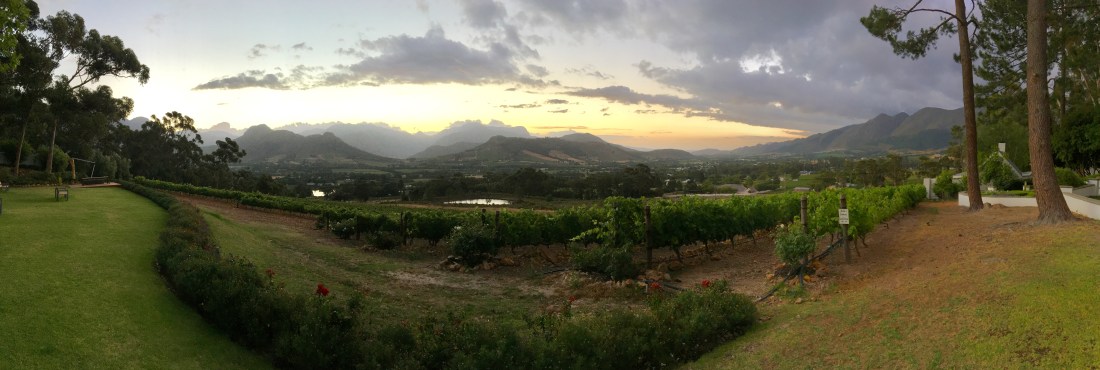
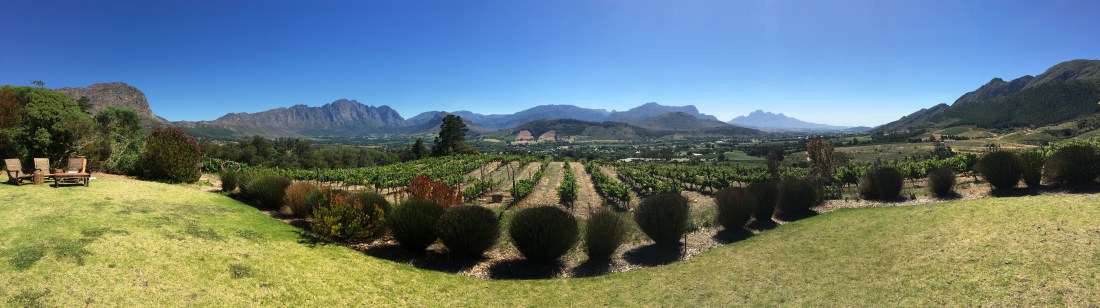
After that success, we headed back to the hotel to play our instruments and get ready for dinner. Despite our friend (you know who you are, Jeannine) recommending a non-existent restaurant the previous day, we gave her one more chance and booked what she describes as her favourite place in the whole world, La Petite Ferme. She has travelled extensively so this was high praise. And the restaurant lived up to the hype. It is in a beautiful situation, partway up the Franschhoek Pass road with a broad, open outlook across the valley. Time for another of Ishbel’s panoramic shots…

IMG_0338.jpg

The food was amazing. I had the Slow Roasted Pulled Lamb, with all kinds of funky accompaniments and Ishbel had the Southern Chicken Drums with equally interesting accoutrements. Every time I describe a meal, I realise how unworthy I am of the Instagram generation as I keep forgetting to take pictures of the food in its pristine condition on arrival. I will try to do better in future.

I can’t let the day pass without mentioning the passing of Pete Shelley of the Buzzcocks. The band produced immaculate pop songs during the punk revolution of the seventies. Ishbel went with her sister Marjory to see the re-formed group in Brighton 2 years ago. I couldn’t go as I was off watching football somewhere so the last time I saw them live was 40 years ago at the Loch Lomond Festival, where they were third on the bill of the second day, behind the Average White Band and the Boomtown Rats.

Watch the pop genius at work here.