A Hiroshima pilgrimage

We were awake early on Monday morning and quickly packed for the next leg of our Japanese adventure, saying goodbye to our little Osaka AirBnB studio flat. We were bound for Hiroshima, so had to take a train to Osaka, then change and catch another for Shin-Osaka before we could catch our Shinkansen bullet-train to Hiroshima. As we’ve come to expect, everything happened precisely on time and we were quickly and efficiently on our way.

I had managed to get us a deal for £80 a night at a hotel right at Hiroshima station. The Hotel Granvia is one of a chain of station hotels in Japan. The place is clean, modern, and pleasant to spend time in, much like Japanese trains and stations. The other advantage of staying here was the fact that we had to tote the bags only a very short distance after arriving. This meant we were at the hotel by noon. With the official check-in time being 2:00pm, we checked our bags, picked up a map of the city, and headed out.

We were both born at the tail end of the 1950s and, growing up in the 60s and 70s, Hiroshima was a name with which we were all too familiar. We grew up with a kind of nuclear anxiety, too young to comprehend the events of the Cuban missile crisis but keenly aware of a general consciousness that the world could end at any moment in a nuclear holocaust. Hiroshima was, and still is, one of only two cities ever to have been struck by a nuclear weapon. It represented that potential for devastation in our minds. So, when we actually arrived here, our first destination was somewhat pre-ordained.

dsc_0235

If you’ve ever seen a picture of Hiroshima after the bomb was dropped, you’ll have seen the single building, ruined but still standing, in a landscape otherwise almost completely levelled. That ruin stood untouched until the start of reconstruction in Hiroshima. There was a great deal of controversy around what should be done with it. Many survivors would have preferred not to be reminded of that day, while others felt that there should be some monument to the events of 6th August, 1945. In the end, the decision was reached to preserve the ruin as a reminder to the world. Alongside it, a Peace Park has been constructed which contains various monuments and exhibitions.

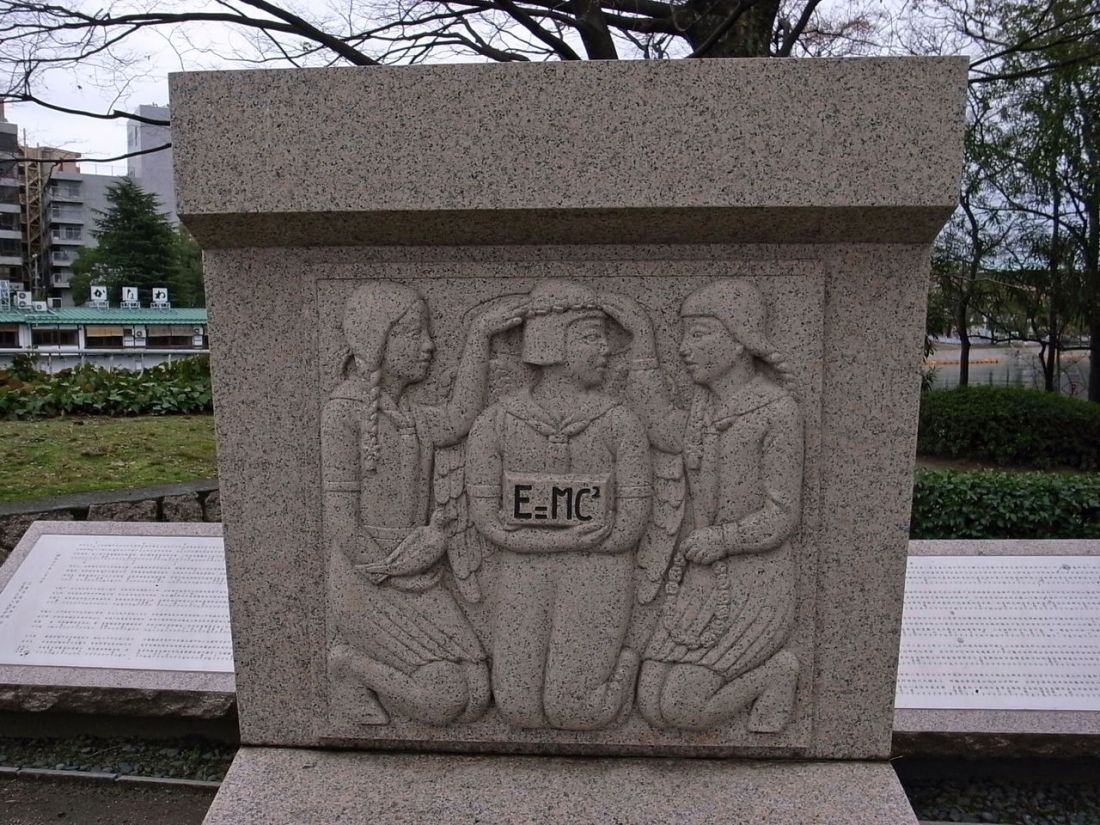
The Peace Flame was lit in August 1964, the monument itself having been designed by Kenzo Tango – the same man who designed St. Mary’s Cathedral in Tokyo. Also in the park is the Hiroshima Peace Memorial Hall. The hall includes a diorama view of the city taken by US military personnel a few days after the bomb had struck. The image is composed of a mosaic of 140,000 tiles – the number of people estimated to have died in the attack. Incredibly, this figure is provided with a margin of error of plus or minus 10,000. There is also a video presentation where the recollections of survivors and the bereaved can be heard. They talked about the loss of 544 first and second year students from the Hiroshima Municipal Girls’ High School. There’s a monument to the students killed in the attack and the inscription on it of Einstein’s famous formula that defines the energy released in a nuclear reaction.
emc2 hiroshima

The visit to Hiroshima was something of a pilgrimage for us, and this was a sobering experience.

We travelled to and from the Peace Park by tram. Yet again, our Tokyo-bought Pasmo travel cards operated seamlessly on the tap and go readers on the cars. The train station was the central terminus for all routes, so our hotel was perfectly situated for us to see more of Hiroshima. After taking a few moments with our thoughts, we headed out for dinner. We had picked a burger and craft beer place called Kemby’s and I was looking forward to it. Unfortunately, when we got there it was closed which forced me to learn yet another fact about Japanese culture.

There is a national holiday on the second Monday in January called “Coming of Age Day”. It is intended to celebrate Japanese youth reaching the age of majority – currently 20 but dropping to 18 in 2022. We ate in a small Japanese restaurant then walked back to the hotel. Our walk home coincided with a lot of the Coming of Age Day celebrants departing whatever festivities they had been participating in. Imagine, if you will, the scene if the whole of the UK held Sixth Form leaving balls on the same day. That appears to be the general vibe, particularly among the lads. The girls seemed altogether more sober, literally and figuratively.

It was an interesting day in Hiroshima, a city whose name is stamped indelibly on history but which, 70 years after that defining moment, goes about its business like any other world city. It’s a testament to their powers of recovery that this is the case. I’m glad we came here. 

“I’ve watched C-Beams glitter in the dark near the Tannhauser gate.”

Today’s title is lifted from the “Tears in rain” speech made by Rutger Hauer’s character, Roy Batty, in Ridley Scott’s 1982 masterpiece, Blade Runner. We moved from Kyoto to Osaka on Saturday so we’re having a Saturday night in the city that inspired much of the set design for that movie. It was also the setting for Scott’s later (underrated) Black Rain.

Before we get to the neon glitz and 3D animated restaurant signs, we first had to manage the journey. When we arrived in Kyoto, we took a taxi from the main station to our ryokan but, after two days of eating nothing but Japanese food, I felt prepared to meet any challenge the transport system may have for us. After breakfast, we packed up and checked out. We then walked down to the nearest subway station. I have been very impressed by the widespread availability of elevators in stations. They are very helpful when, between us, we have two suitcases, a dobro, a mandolin, a camera backpack, a handbag and a man-bag. The lift helped ease us down to the right platform for a subway to Kyoto train station.

Once there, we decided that we would take a local train that would take us direct to Osaka station. Our pass entitled us to take the bullet train, which is faster, but it stops at a station called Shin-Osaka where we would have to change to get to Osaka so we decided the convenience was worth the slower journey. We got to Osaka at around 11:30 and we were booked at an AirBnB where we couldn’t check in until 3:00pm. Luckily, all Japanese stations are equipped with a vast array of luggage lockers and a left luggage counter, so we were able to store all of our bags and start being tourists immediately.

Well, immediately after a cup of English Breakfast tea, which wasn’t available at the ryokan so we were going a bit cold turkey for a proper cuppa. Over our tea, we looked at what was available for us to go and visit, and settled on the Osaka Museum of Housing and Living. This was a short subway ride away and, once again, our Pasmo cards worked seamlessly on the Osaka urban transport system.

The museum itself featured scale models of Osaka showing its growth over the centuries. It also had a full scale reproduction of some city streets that we could walk through and learn a little more about Japanese life in the mid-19th century. It’s not a huge museum but well worth a visit if you have an hour or two to kill in Osaka. After the museum, we went for a stroll down a covered market street. I was impressed by the effort that went in to this particular drain cover:

2 - 1 (2)We’ve since seen a few more cast in the same way but this is the only one so far that’s been painted. This street also gave me the opportunity to try another typical Japanese activity: Pachinko. The aim of the game is to fire little silver balls into a hole. I played for about 15 minutes and still have no idea how it works. I see no need to attempt a repeat experience.

It was time to head to our AirBnB which is a short walk away from Fukushima station on the JR Osaka Loop Line. Because it’s a JR line, we were able to travel for free with our rail passes. The flat is best described as compact, but that is what we were expecting from Japan so it didn’t come as a shock. After settling in and buying some of life’s necessities (tea bags and milk), we decided to head out for dinner. I was keen on some comfort food, so we found a little Italian place just around the corner from the flat. It had a Google Rating of 4.5 from 148 reviews, which is pretty decent for that number of reviews. We arrived at 5:20pm, and there was already a line of people waiting to get in when it opened at 5:30.

The pizza was amazing. The patron/chef/waiter is a one man whirlwind. There is no other staff. You order your pizza from him at the counter. You tell him what you want to drink, then you help yourself to the drink and open it yourself. Regalo is highly recommended if you find yourself in Osaka in need of a pizza.

After dinner, we really had to pay a visit to Dotonbori, the canal-side area famous for its neon signs, animated large scale food reproductions and vast quantity of restaurants.

There is a remarkable Japanese word, Kuidaore, meaning to ruin oneself by extravagance in food. It seems to have been coined for Dotonbori.

The most famous sign of all in this area is the Glico running man, which has been a Dotonbori icon for over 80 years.

img_3269

After taking this shot, we strolled along the main drag and, at one point, we were stopped by a young Australian lady who asked if we had seen the running man. She had somehow missed it and needed directions which we were able to provide.

I’m amazed by how completely different a feel there has been to each of the Japanese cities we’ve visited so far. I’ve discovered, however, that the Japanese themselves perceive residents of each city to have differing vices. As mentioned above, it’s food here in Osaka. In Kyoto, it’s clothing – specifically kimonos. And in Tokyo? Footwear apparently. They love a shoe over there.

Turning up and turning down, I’m turning in I’m turning round…

Our first full day in Tokyo and I couldn’t resist stealing the title of today’s post from The Vapors’ 1980 pop-punk classic, Turning Japanese. A cliche, but I like it.

We were awake fairly early and quickly realised that the industrial chic decor of our AirBnB doesn’t do a lot for keeping in the heat or keeping out the cold. We switched on the heater and waited for the room to heat up a little before starting our day. The intention for today was to see some of the guidebook sites for the city, so we decided to head over to the Meiji Shrine. The Emperor Meiji, a near contemporary of Queen Victoria, was the 122nd emperor of Japan ruling from 1867 until 1912. It was he who liberalised Japan to a great extent, laying the foundations for it to become the industrialized power that it is today.

IMG_3120.JPG

He, together with his wife the Empress Shoken, is still greatly revered by the Japanese people and the shrine was built through public donations and was officially finished in 1926. It’s a Shinto shrine; a religion about which I haven’t previously had much knowledge but is not based on a deity. Or, it’s based on the belief that deities are everywhere. I’m still not sure which.

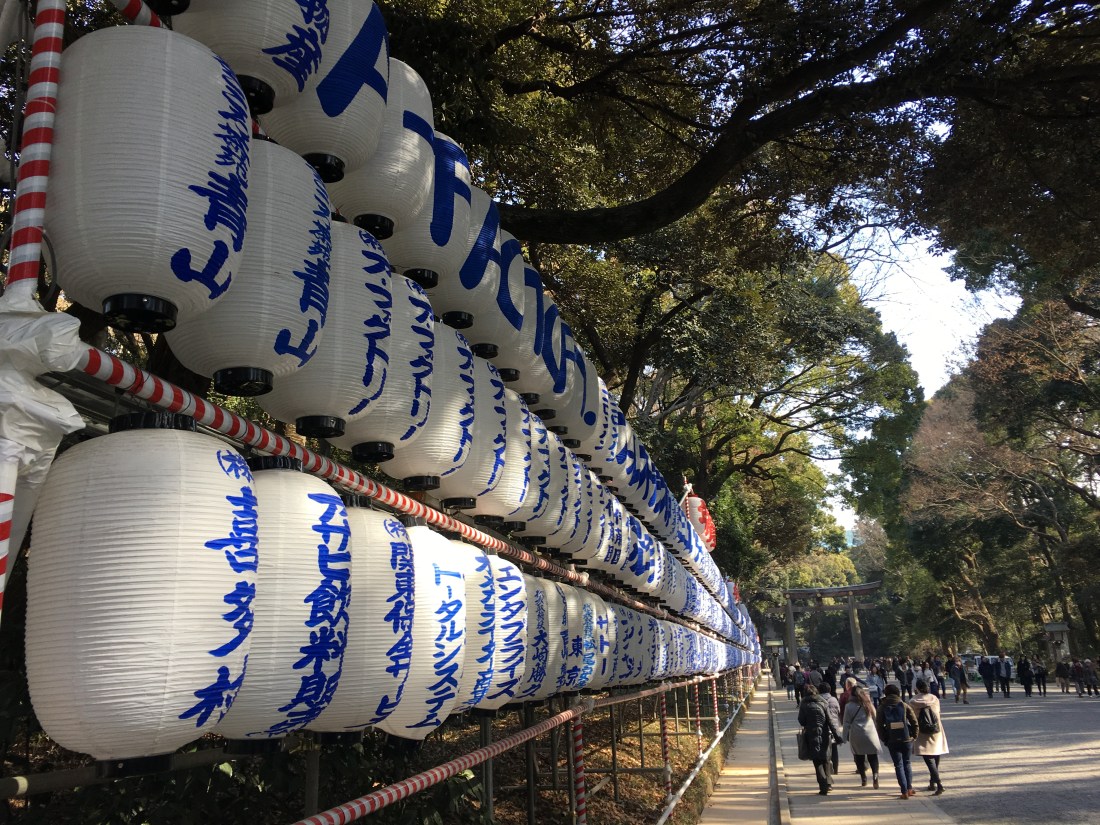
We had a pleasant wander around the grounds here, and were interested to discover that there was an exhibition of schools’ calligraphy as part of a competition. img_3121

We also discovered that, during his reign, the Emperor Meiji not only started eating western food but, on occasion, would enjoy a glass of wine with it.

dsc_0066That’s why there were several barrels of burgundy donated as part of the consecration ritual for the shrine.
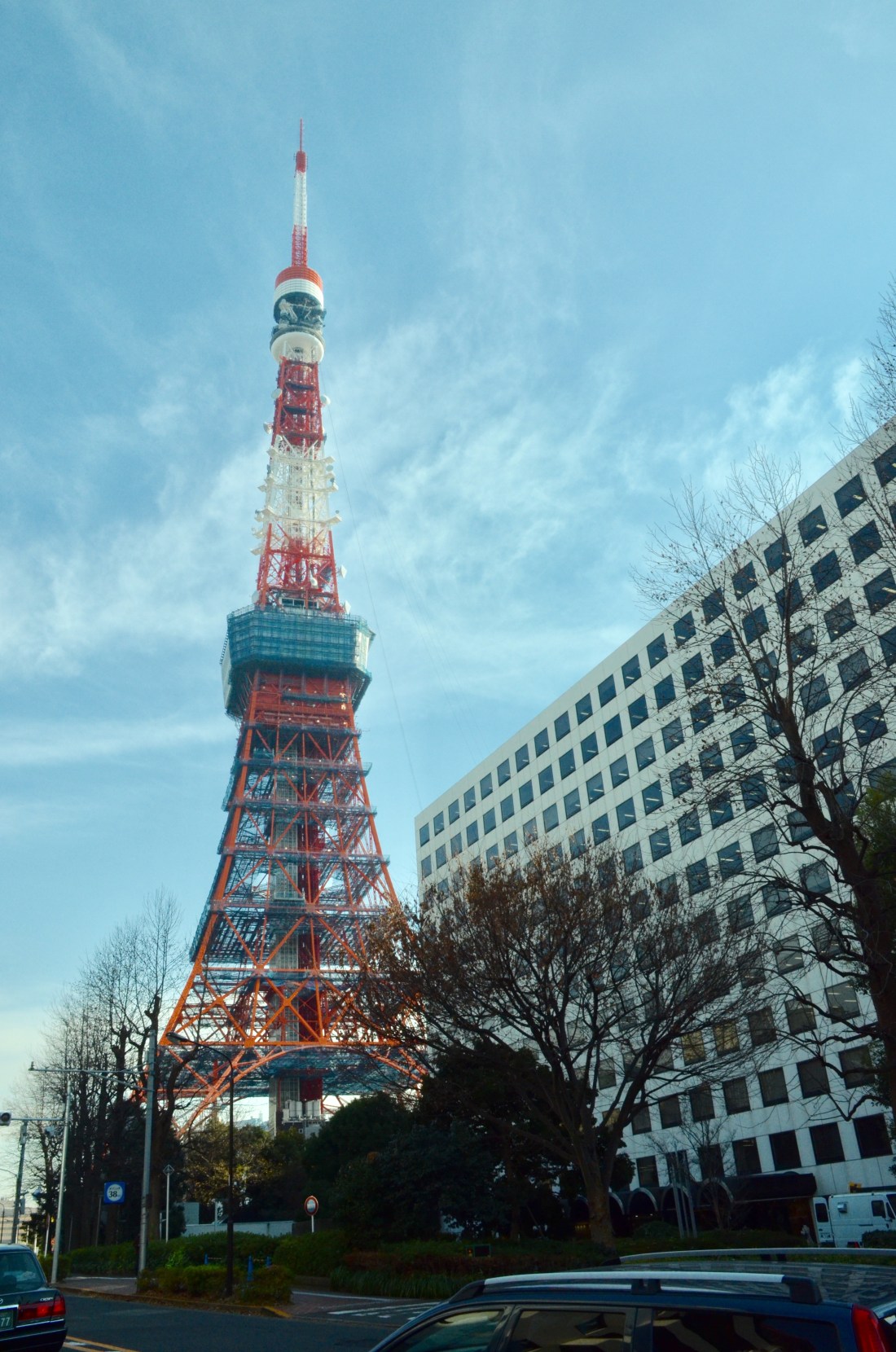
From here we decided we would go to the Tokyo Tower to get a good view of the whole of Tokyo. It was a cold, crisp, sunny day so hopefully a good time to enjoy the view from the top. To get there, we once again took the subway. On the way to the shrine, we had acquired Pasmo cards – the equivalent of London’s Oyster cards (or Hong Kong’s Octopus). It is really very convenient and you can speed your way through the subway system. I believe it was not always the case in the past, but the system is now very easy to negotiate as there is plentiful bi-lingual signage and most announcements are made in English as well as Japanese. Having the stations on each line sequentially numbered is also very helpful.

So we arrived at the Tokyo Tower, and faced the decision of whether to buy a ticket to go just up to the Main Deck, or all the way to the Top Deck. The tower is a little higher than the Eiffel Tower which it closely resembles, but the Top Deck is at 250m, some 25m below the highest observation deck on the Parisian structure. If you recall, I mentioned Ishbel’s unhappiness with heights when we were on the cable car at the Wynn Palace in Macau. She was a little reluctant to go to the Top Deck, but she agreed to try it after a little gentle persuasion. I still have fingernail marks in my hand where she was holding it as we took the glass lift up to the last level. Nevertheless, she got used to it and the views were definitely worth the ascent.

dsc_0080After getting back down to ground level, we took a little stroll around the area. There’s an interesting phenomenon here around how restaurants attract passing trade. Some of them have menus with pictures on them which allow non-Japanese speakers like ourselves to simply point and smile to get what we want. Others go one better.
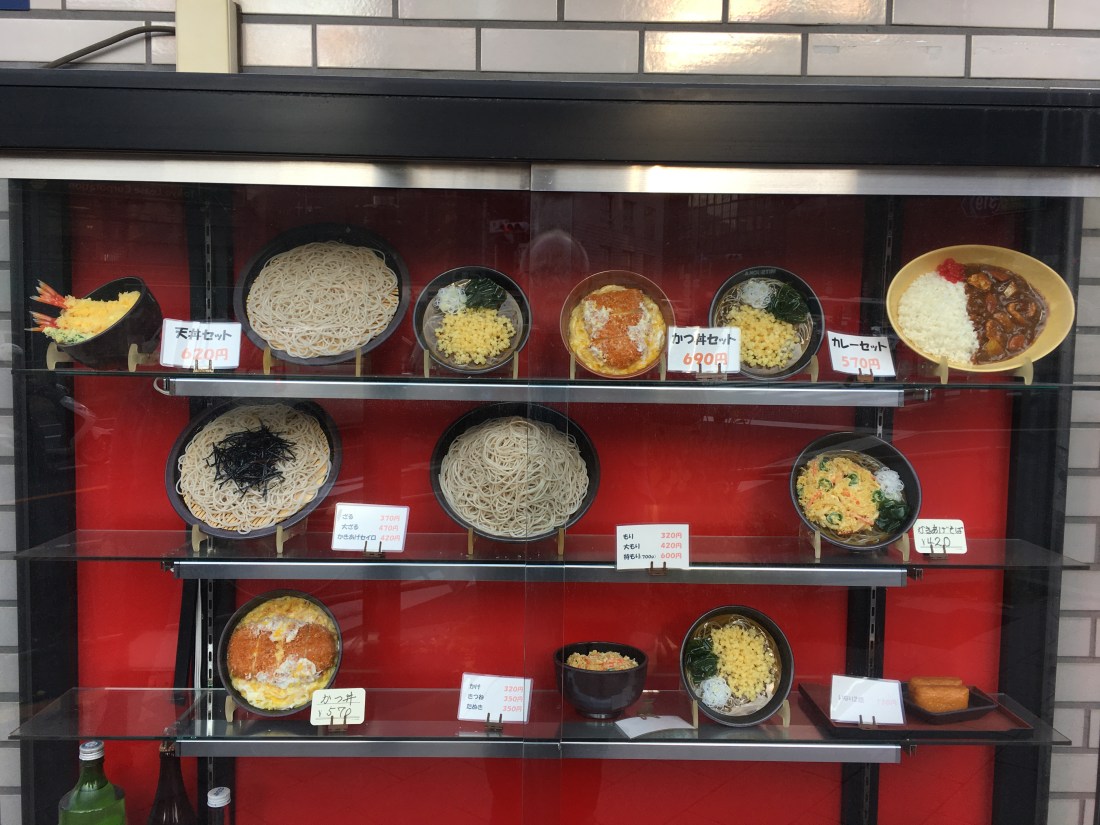
img_3146They display what I sincerely hope are artificial reproductions of the food available inside. This isn’t something I’ve ever encountered before and I really like it.

We didn’t have dinner in this place, despite its tempting window display. We ate instead at a place called Kushimura, a Yakitori restaurant in Roppongi, a 15 minute walk from our flat. The food is skewered and cooked over charcoal right in front of you and it is truly delicious. We enjoyed about a half dozen skewers each, which was plenty. I don’t mean to tell tales but the guy next to us had about 20 all on his own. I guess it all depends how hungry you are when you get there.

And so ended our day as we walked back to the flat in freezing temperatures. Japan is really our only true winter stop on the entire journey. As such, we compromised somewhat in our packing and don’t have any winter clothes with us. And it is cold here. We’re throwing on multiple layers to try to cope with it and so far, so just about bearable.

Hong Kong to Tokyo – First impressions of Japan

An easy start to the day today as we re-packed the small amount of gear we had taken out of the suitcases and took a leisurely stroll from the hotel on to the departures level at the airport. Check in was painless as we checked the bags and walked the guitar case over to the outsize baggage counter.

img_1329

They were kind enough to put on a “Fragile” label, but the green spangly case is starting to pick up a bit of character from the journey.

I’m sorry to keep comparing BA unfavourably to Cathay Pacific but, once again, the service was perfect. We even received a text while sitting in the lounge informing us that the flight would be delayed by 15 minutes. BA doesn’t even regard 15 minutes as a delay.

Anyway, we were loaded and away not too long after the scheduled departure time for the quick 4 hour hop to Tokyo. That gave me enough time to watch Deadpool 2 on the huge screen that is so much better than BA. Sorry, but it is.

img_3114Landing in Tokyo, we were quickly through immigration and the bags were waiting for us when we got to baggage reclaim. Then we were straight out through customs and facing, once again, a land where we don’t speak a word of the language or read a letter of the alphabet. Not quite true. We now recognise one character, which is the same in both Chinese and Japanese: 人 means people. OK, not all that helpful, but it’s a start. 
We knew that our target was Akasaka station, on the Chiyoda line of the Tokyo underground system. The nice lady at the airport ticket office sold us a ticket for the Skyliner express train, which would take us to Ueno where we would change to a train to Nishi-nippori, where we would change on to the Chiyoda line to Akasaka. Easy peasy, Japanese-y.

And then a strange thing happened. As we struggled on to the Skyliner and tried to stow all our bags in the limited available space, we were helped by a young man with a Scottish accent. It turns out he’s been living in Japan for the last two years working in robotics. Also, he’s a Glasgow University graduate, and studied Computing Science, just like I tried to do back in 1977. We had a lovely chat with him on the ride in and he gave us his business card so we could contact him if we needed help while we were in town, which was really nice of him.

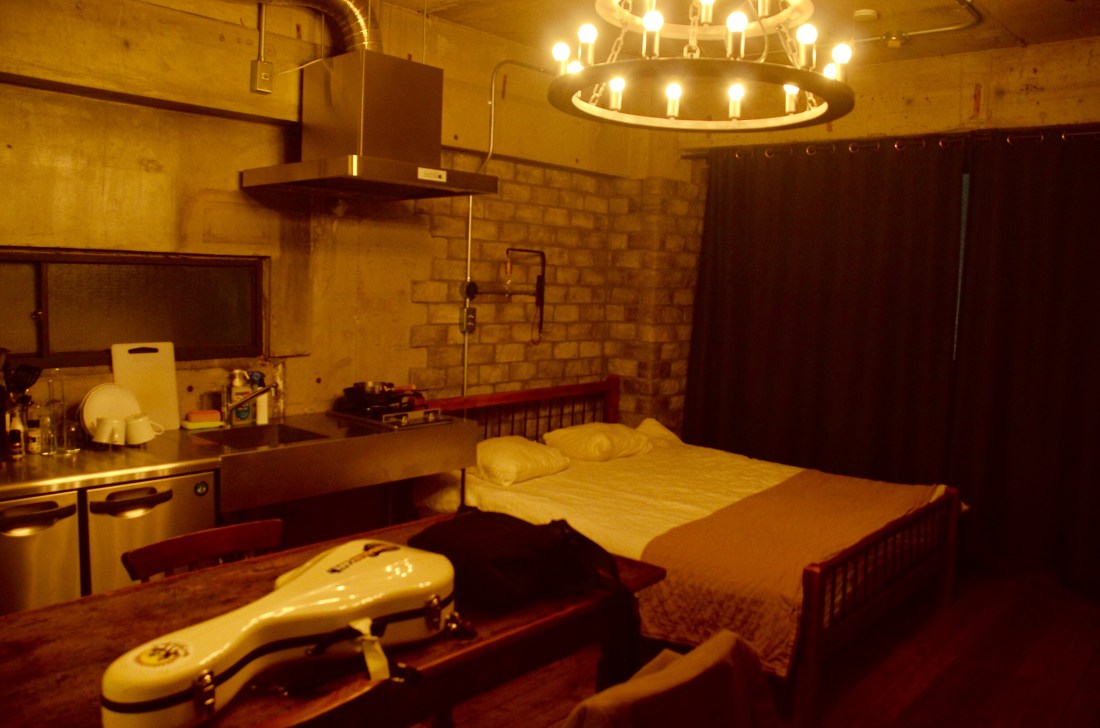
We completed the rest of the journey safely, although I was constantly confused by escalator etiquette here (stand on the left, walk on the right) which is the opposite of the London Underground. I think we just managed to avoid the start of the real rush hour as we emerged from Akasaka station and took possession of our AirBnB. It’s a charming little place that the landlord has set up to look like a post-industrial loft. All bare wood, exposed brick and concrete.

dsc_0002dsc_0004We then had the interesting task of figuring out how to flush the toilet. I had been warned about this in advance by a colleague who had recently visited Japan but any pearls of wisdom he provided had since deserted me.

img_1334

A combination of Google and trial and error got us there in the end.

Having settled in to the apartment, we decided to stretch our legs and get in a couple of necessities. Tea bags and milk, primarily. It turns out that we find ourselves in quite a lively part of Tokyo. Bearing in mind that this was about 8pm on a Monday evening, there was a remarkable number of significantly pissed-up salarymen roving the streets in large groups. Dark suits and dark overcoats are still the standard uniform – it doesn’t look like the permanent dress-down or business casual approach has yet been embraced over here.

The other surprising phenomenon was the cycling culture. We have always assumed, perhaps in an ill-informed and stereotypical kind of way, that the Japanese respected order and rules are expected to be obeyed. There is a significant number of cyclists who don’t play that way. A lot of them are cycling on pavements at speeds that don’t seem safe for them or us.

Anyway, we found a little supermarket where we acquired the requisites for a cup of tea, and also food for breakfast the next day. That will be the first meal we’ve prepared for ourselves since the 16th of December in Johannesburg. It’s a tough life.