One week over, thirty-five to go

As Thursday dawns in Hermanus, we realise that we have completed our first full week on the road. We will be travelling for 36 weeks in total, returning to the UK on 8th August next year, so we’ve used a mere 2.77777% of our journey time.

Sadly, our hotel breakfast this morning did not include whales. We re-packed and loaded the car. All of our luggage fits just about perfectly in the boot of the Toyota Corolla that Avis provided at Cape Town airport. We re-fuelled the car for the drive, at a cost of 83p per litre, and set out for our next stop in Franschhoek.

We took the scenic route to get here, passing through the town of Caledon, which, despite its Wikipedia page,  is not at all scenic. It has a lot of heavy industry and a fringe of shanty towns which, presumably, supply much of the labour. Otherwise the route itself was very pretty. The drive across the Franschhoek pass (Ishbel’s panoramic shot above) and down into the town was amazing, with lots of hairpin bends and outlook points over the valley below.

We came in to the town past the Huguenot Monument, which dominates one end of the Main St, and parked in the centre. Almost the first thing that greeted us was a wine display.
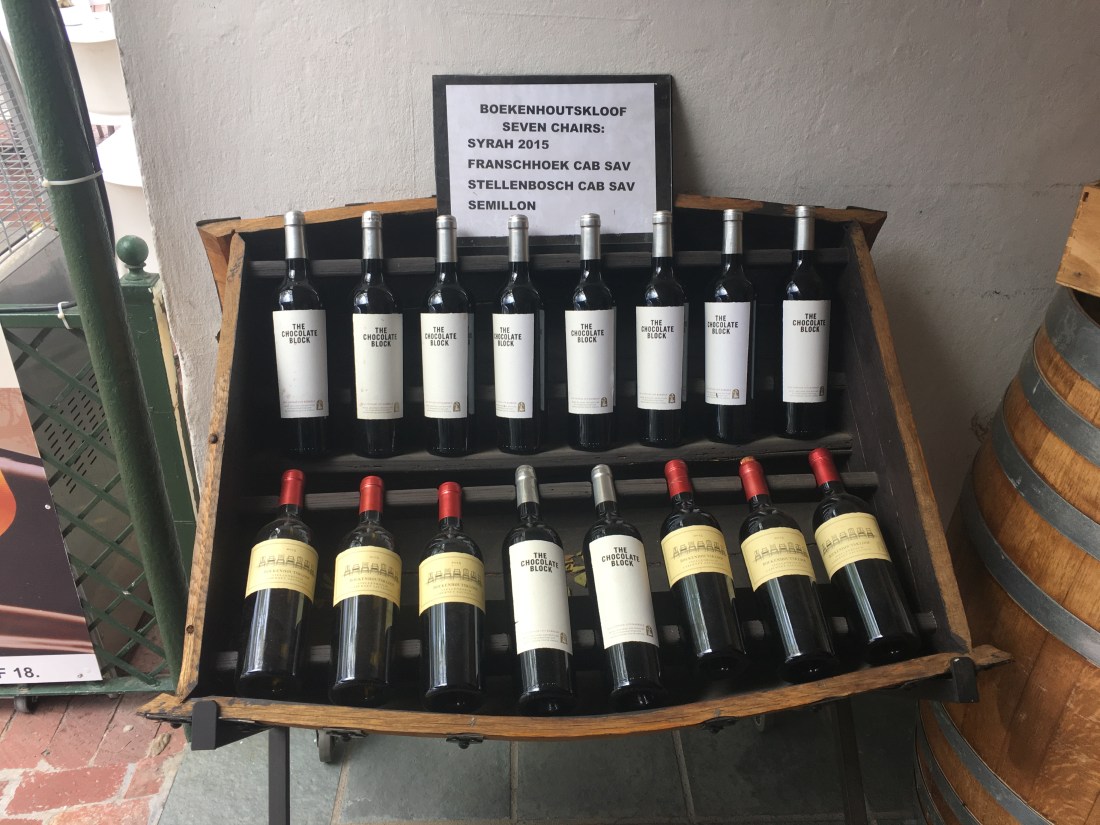
IMG_2896The Chocolate Block is a magnificent wine and an excellent accompaniment to the food in Waitrose’s Steak and Oyster bar in Canary Wharf. Don’t ask how I know this. I just do. I was disappointed to learn that the winery that produces this little stunner, Boekenhoutskloof, is only open for tastings twice a week, at 11am on Tuesdays and Thursdays. We arrived too late on the Thursday to visit, and leave too early on Tuesday. We’ll just have to make do with one or two of the other 45 wineries around town.

To get to our hotel here, Val d’Or Estate, we had to drive all the way through town and a couple of kilometres further on. Franschhoek is very much geared towards tourism and all of the hotels and guest houses are very well signposted so we had no trouble finding the turn off. We unpacked, settled in to our enormous room, and enjoyed a glass or two from the complimentary bottle of wine provided to us on arrival. There’s no restaurant here, so reception made a booking for us at a restaurant recommended by a friend who has visited the area regularly. They also arranged a driver to take us there and back.

The driver arrived promptly at 6:45 to get us into town for our 7:00 reservation. We told him the name of the restaurant, Dutch East. “It’s gone”, he said. I was surprised that it should have disappeared in the three hours since our booking had been made, but it transpires that a new restaurant has opened up in the same space, and with the same phone number. It’s called Bovine, and obviously specialises in beef.  He gave us a brief tour of other restaurant possibilities but we decided to honour our reservation and eat there. It was very good, with Ishbel having the lamb belly, and me, the fillet steak. They also offered a wine flight which we both had.

IMG_2901

This was the premium flight, since the standard selection had no reds.

As we ordered dessert, the restaurant started preparing for load shedding as another power cut was imminent. I wanted to use my Revolut card to pay so I asked for the bill immediately before the power went off. During power cuts, shops and services take payment in the charming old school way by swiping your card in a machine with carbonless copy paper to take an impression of the raised numbers on its face or, of course, cash. Interestingly, the Revolut doesn’t have embossed numbers so that method doesn’t work for it. By the time dessert arrived, we were fully candlelit in the restaurant and the lights were off all across town.

After dinner, we took a little stroll along the main street and noticed that there were some places still lit. We were tempted in to the Tuk Tuk Microbrewery, who obviously had a generator to ensure conditions could be maintained in their brewing room. I had a really good pale ale in there before we asked them to contact our driver who arrived promptly to pick us up and return us to Val d’Or. On the way home, we negotiated an inclusive deal for him to take us to our restaurant for the next night, and to give us a five hour winery tour on Monday. All that to look forward to in the coming days.

Whales for breakfast

As mentioned previously, our Hermanus hotel is right on the coast. We had a lovely sea view from our room and breakfast was served in the restaurant which, provided you got a good table, also had an uninterrupted view over the ocean. Thus it was on Wednesday that we went down for breakfast and, as the first pot of tea arrived (one pot is never enough), so did the whales. We delayed our breakfast for ten minutes as we popped across the road on to the cliffs to watch two whales in the same cove where we had seen them on our first day. There were a couple of early start whale-watching boats beyond the whales but they were viewing them from further away than our own shoreline vantage point. Eventually the whales disappeared and we returned to enjoy breakfast with smiles on our faces.

After breakfast, we took a walk into town and wandered into a couple of the art galleries that are a staple of tourist towns around the world. Equally universal are the outrageous price tags you find on the works there. Perhaps they think that tourists who like art will be bad at arithmetic and won’t realise that the sterling equivalent of that price is close to £3,000. We smiled sagely, feigned interest and then, as tabloid reporters used to say, we made our excuses and left.

Ishbel decided that the small hotel pool had lost its charm and set about researching an opportunity for an oceanic swim. She found that there was a Blue Flag beach just along the road, so we headed over there. Grotto Beach is at the start of an extensive range of white sand beaches along Walker Bay. With a water temperature of 16C I wimped out, but Ishbel went for it, striding off into the breakers for an invigorating swim. There was a stiff breeze blowing and the sand was so fine that it got everywhere.

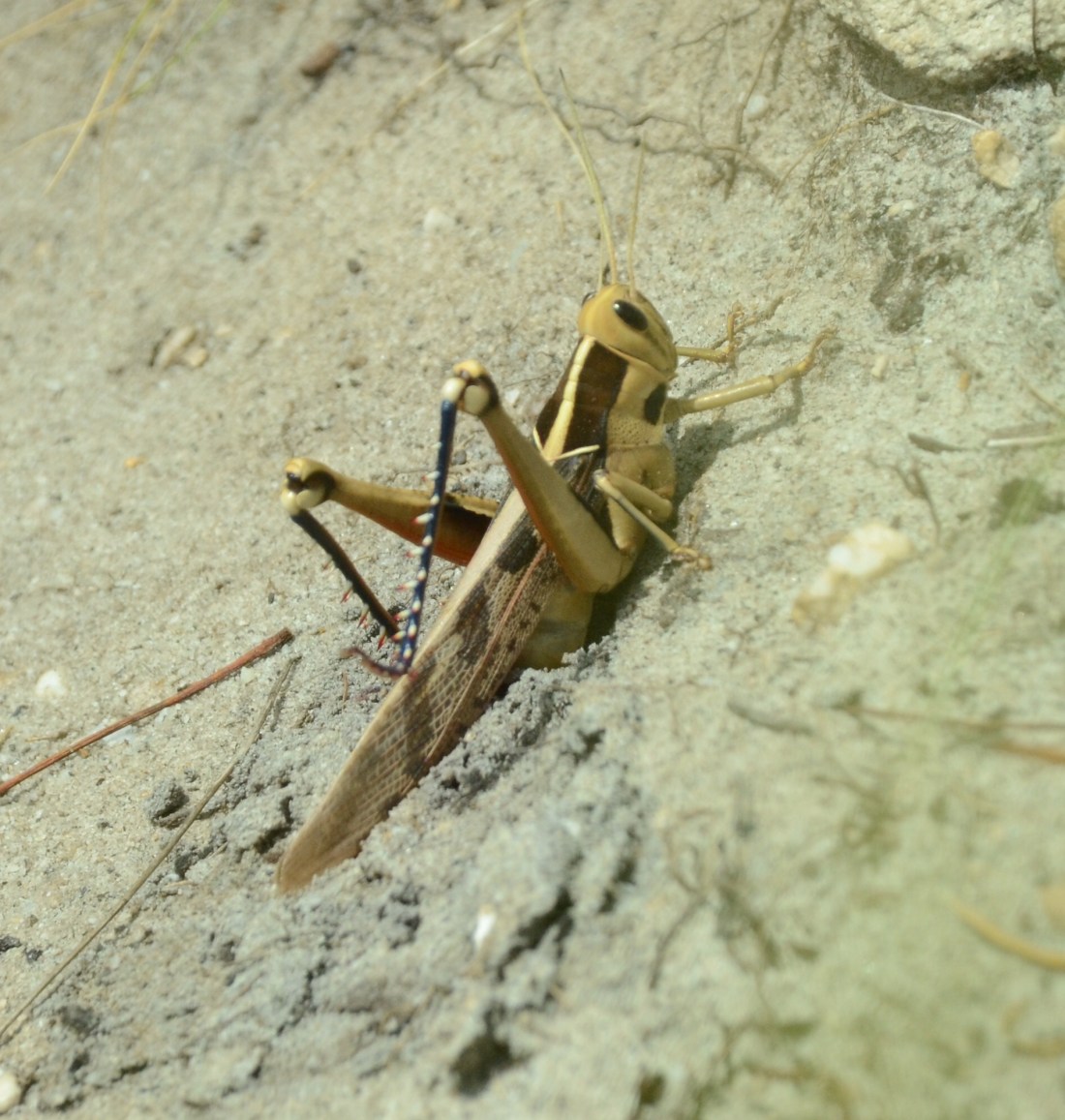
After Ishbel got out of the water, dried off and changed, we headed back towards Hermanus but took a detour into Fernkloof Nature Reserve. We did one of the shorter hiking trails there. Not much by way of animals, but we did encounter a red locust.

DSC_0025

We then relaxed for the rest of the day and played our instruments, as we have been doing most days. In the evening, we walked into town to have dinner overlooking the water but first took a walk along the cliff path to Roman Rock. We had seen signs to it and it had piqued our curiosity, Ishbel even going so far as to investigate how far south the Romans had made it. Not this far south was the answer. Intrigued as to how it got its name, we thought we’d take a look in case it looked like a centurion’s helmet, or a laurel wreath. It looked like a rock, so we’re none the wiser.

We had dinner in a place called Coco’s. A number of restaurants were vying for our business, but Coco’s had the advantage of upstairs windows looking straight out to sea. I had fish and chips and Ishbel had a burger, both of which were good. After that, a stroll back to Hermanus for our last night in the hotel before heading off to Franschhoek.

Some sweet day I’ll make her mine…

Well done if you got the reference to the Manfred Mann song Pretty Flamingo since that was our big new fauna experience for Tuesday. We started the day with a brisk walk to the New Harbour to build an appetite for breakfast. The harbour is a working one and not what you could realistically describe as picturesque. It’s a small industrial estate with a couple of whale watching tours for the visitors. After breakfast, we came to realise that we find ourselves in Hermanus in what is probably the off-season for them. The main whale watching season is over and we’re not at the height of the summer. We’re headed to Franschhoek on Thursday, which is in the heart of wine country, so we’re saving our wine tours until then. That leaves a somewhat limited range of options with which to amuse ourselves locally.

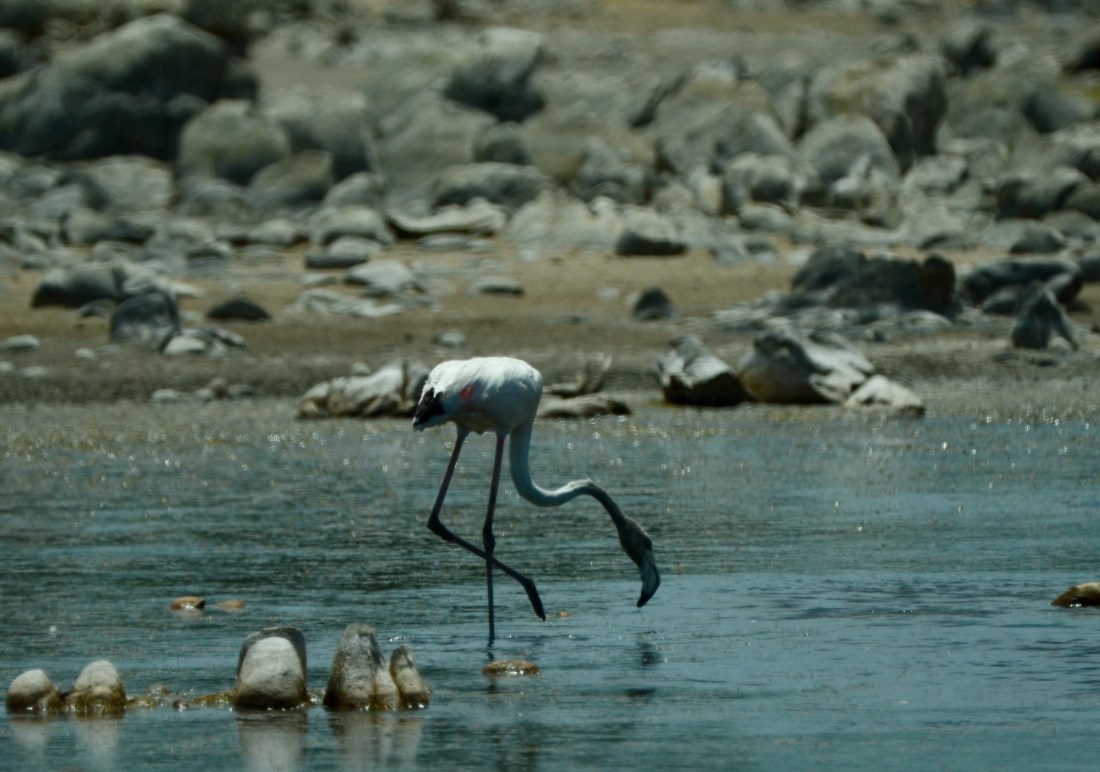
Ishbel to the rescue, though. She discovered that there was a salt pan along the road in Vermont which is home to a range of bird life, including flamingos. Off we duly went to see what we could spot. After parking up at the salt pan, we spotted flamingos at the far side of the water so started along the path around the shore. We encountered a local who was out walking his dog and asked if it was possible to get around to the side that the flamingos were on. Apparently that side was all private property and the route was fenced off by the owners. He also said we should have been there a month or two ago as there were 200-300 flamingos then. The message here is, if you want peak flamingos and whales, come to Hermanus in October. There were still around a dozen flamingos there, a mix of lesser and greater flamingos. That’s a greater flamingo pictured above. There were also a number of occupied grey heron nests on the water. A successful trip.

Our first night here, we had eaten in the restaurant attached to the hotel, The Heritage Cottage. Ishbel had a nice confit duck leg and I had enjoyed a surf and turf which featured an exquisite piece of fillet which apparently originated in Mozambique. While that meal was delicious, we thought we’d go for something a little more down to earth. I attempted some research and was surprised to discover that a lot of the restaurants here only open for dinner on the weekends. Eventually, we settled on an Italian called Fabio’s, partly because of its proximity to the hotel.

Power cuts were expected again that evening so we decided to eat reasonably early. As a novelty, we shared a plate of springbok carpaccio as a starter, while Ishbel ordered penne puttanesca and I had the chorizo and prawn risotto as mains. The carpaccio was fine and Ishbel’s pasta was good. My risotto was awful. The prawns were overcooked and rubbery, the chorizo wasn’t chorizo, and the rice was watery rather than creamy as it should be. We won’t be going back there.

After dinner, we decided to take a walk along the front. There was quite a wind blowing in from the sea and the temperature had dropped a few degrees. However, almost the first thing we saw when we got to the shore was a whale jumping in the bay. Again, there were two whales together and they cavorted around for about 15 minutes. We’ll be happy if we maintain our whale a day average while we’re here.

Whale season is over…

Planning for eight months of travel to places where, for the most part, you’ve never been before is a bit of a guessing game. You’re never sure how long will be too much or too little in each stopping point. The major flight stopping off points are cast in stone at the point of booking but the additional side trips could be left more flexible. Except for the fact that I like to know what I’m doing and when I’m doing it. So, as mentioned in a previous post, the first month and a half of accommodation were booked well before we left the UK.

Thus it was that we left Cape Town on Monday. I had booked three nights in a hotel in Hermanus, a former whaling village and now resort town famed for its whale watching opportunities. We had been warned that we were approaching the end of the season as Southern Right Whales make their way to Antarctica for the summer but we were already booked for Hermanus so we were going. There’s a direct route from Cape Town down the N2 and on to the R43. Looking at the map, however, there is a coastal route that goes around the Kogelberg Nature Reserve, so we decided to try that.

We took the N2 until the turn off for the R44 then hit the coast at Gordon’s Bay before turning on to what turned out to be a magnificent drive. It had been raining for most of the drive out of Cape Town but it had dried up by now, although it was still overcast. The road itself had obviously been recently resurfaced and its sweeping bends and elevated viewpoints, thanks to it having been hewn out of the cliffs, were a joy to drive. One point to note is the number of small, and larger, rocks that had fallen on to the road. We may have encountered a higher incidence of these because of the heavy overnight rain.

On the way along the road, we saw numerous baboons amusing themselves and had to be careful to avoid some of their rambunctiousness as juveniles rolled into the road during their play-fighting.

IMG_0187

On to Hermanus, and we arrived at the hotel at around 1:30. We knew we were a little early for standard check-in time but the manager told us that the room was almost ready. If we wanted, we could pop across the road from the hotel and see the whale that was in the cove there until the room was ready. We decided that was a great idea, and watched the whale (Ishbel’s photo at the top of the page) and her calf for around 20 minutes. The whales made their way off, presumably antarctic-bound, and we returned to the hotel to get our room.

The South African electricity supply company, Eskom, has been undertaking a round of what they call “load shedding” which means regional power cuts. This happened a couple of times while we were in Cape Town and Hermanus was in the middle of a load shed event when we arrived here. We realised this was the case on the way in as all the traffic lights were out. Despite encountering what sometimes seems like manic driving on the part of some locals under normal circumstances, behaviour at non-working traffic lights was courteous and practical with each section of the 4-way junction moving in turn. It meant for some slow progress but it was very safe.

After checking in and a little unpacking, we went for a walk into town. On our walk, we encountered the nearest living relative to the elephant: the Rock Hyrax, known locally as the Dassie.

DSC_0355

The elephant, hyrax and manatee share a common ancestor. These are three animals that have clearly taken very different evolutionary paths.

In town, I found a barber shop where I decided to get a beard trim. Ishbel didn’t accuse me of being a manatee, but she did use the term walrus-y in describing my magnificent mustachios so a trim was probably due. Lorenzo’s barber shop did a brilliant job and I should be fine for a few weeks before Ishbel starts again with the marine mammal comparisons.


Greatness and Darkness

Our Sunday started early. We were booked on the 9am ferry to Robben Island so we breakfasted in the flat then drove down to the Waterfront. The area was dead quiet at that time, so we parked easily in the Ulundi garage and made our way to the Nelson Mandela Gateway to catch the boat. We got there by 8:30 and boarding was just starting. It was an easy 30 minute crossing to the island, where we disembarked and were loaded on to buses. Our bus went direct to the main gate of the prison, which took 5 minutes at most, where we disembarked and were greeted by our guide for  the prison tour, Sipho Msomi.

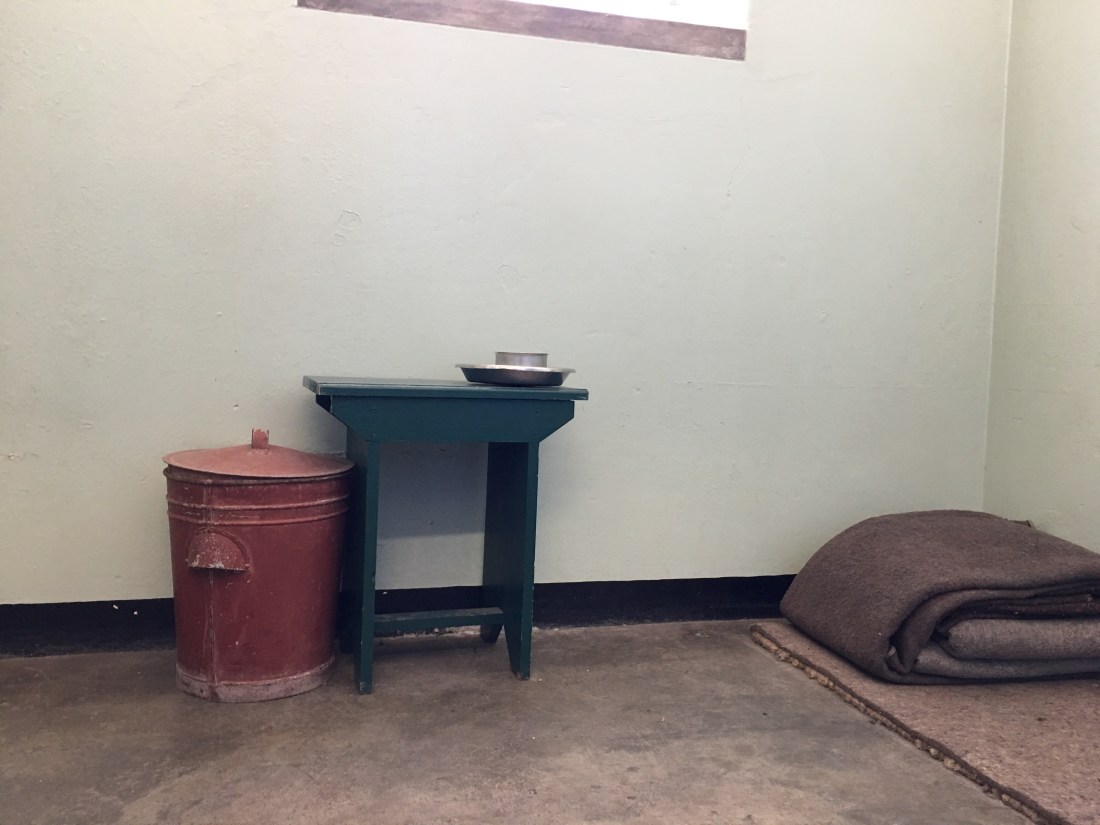
Sipho was a fascinating guide. In 1984, at the age of 22, he was arrested by the South African Secret Police together with 5 of his colleagues. He was held in solitary confinement and periodically tortured for 5 months before coming to trial. At trial, he discovered that one of his friends had died in captivity. He and his surviving four friends were found guilty. Sipho was sentenced to five years on Robben Island for three separate crimes: being a member of the African National Congress; recruiting others to be members of the ANC; campaigning on behalf of the ANC. Although Mandela (whose cell is pictured above) had already been moved to prison on the mainland by the time of Sipho’s arrival, many more of South Africa’s future political leaders remained on Robben Island. Sipho’s knowledge of the history of the place together with his first hand experience of incarceration made this one of the most informative and inspiring tours I’ve ever taken. I highly recommend this to anyone.

Back on the buses after the prison tour, we circumnavigated the island, seeing some of the other structures such as the mosque which was built for moslems taken prisoner by the Dutch East India Company when they were quelling rebellion in Indonesia. We also saw the Robert Sobukwe house where a leading figure in the early anti-apartheid movement and founder of the Pan Africanist Congress was imprisoned. He was kept in solitary confinement on the island and was thought so dangerous that the government passed a law specifically to keep him locked up.

After the boat trip back, we wandered around the commercial hotspot that is the V&A Waterfront. Knowing that you’re on the road for eight months is very liberating when it comes to shopping. You’re just not in the market for anything, unless you’re willing to throw away something you already have to make room for it.

We headed back to the apartment and cooked dinner. Since this was to be our last night in Cape Town, we decided to try to see some live music. Google didn’t seem all that informative about possibilities, but we eventually decided to go to a bar called The Dubliner on Long Street, a seven minute walk from our apartment. We had a couple of beers there and listened to a band comprised of two guitars and a drum machine playing rock hits of the 70s, 80s and 90s. The closest this got to an authentic African experience was when they played Toto’s “Africa”.

More entertaining was the ever expanding street party taking place right outside. There seemed to be a regular procession of minivans with the side sliding door opened, full of young men and women drinking cans of lager and dancing while other dancers kept pace with them along the street. They seemed to be having a lot of fun. I asked the bouncer if this was a regular occurrence. Apparently it happens on special occasions, like end of term or the start of a season. Today’s special occasion was that Cape Town’s Christmas lights were turned on. It sounded to me like they didn’t need much to decide it was a special occasion. The bouncer agreed that any excuse would do.

When we decided to head back to the flat, the bouncer offered to get us a taxi but we were so close and the street so crowded that I thought it better to just walk. We hadn’t gone far when three young men got around us and asked if we wanted marijuana. Some hands came towards me and I knocked them away and hustled the pair of us away from the main drag. The street was quieter here and we made steady progress towards the flat. We were walking hand in hand when Ishbel shouted “Brian!” I hadn’t really paid attention to the youth as he was approaching us but he was now bounding away across the road and down a side street.

“What happened?”, I asked.

“I’m not sure”, Ishbel answered. She then realised that he had tried to rip the small gold chain from her neck.

The kid had ghosted off into the night and the chain and its wearer were undamaged, so we just headed back to the flat at pace and with hyper sensitivity to other people.

We had, of course, been warned about the possible dangers of street crime and, with hindsight, we should probably have taken a taxi at that time of night. It’s possible to get complacent when you’ve gone through your entire life without encountering street crime, which is pretty much true for both of us. We won’t be complacent again.


Gardens and Golfs

We’ve been doing a lot of driving around in Cape Town and a couple of things are very noticeable. First, pedestrians are in no hurry. Ever. People stroll across the road at their own, often leisurely, pace and drivers simply need to avoid them. It encouraged me to do a little research into whether this had any noticeable impact on statistics. It turns out that 57% of all fatalities in Cape Town road traffic accidents are pedestrians. This is something to be wary of if you decide to drive around the city.

The second thing we noticed was the VW Golf. Specifically, the Mark 1 Golf which was superseded in Europe by the Mark 2 in 1984. Not so here in South Africa where Volkswagen decided to continue to produce the Mark 1, branded the Golf Citi, up until 2009.

1992_Volkswagen_Citi_Golf_(9595839015)

It must have been hugely popular judging by the number still on the road here. The reason we have a soft spot for this model is that our first car was a Golf Mk1 convertible, which we only had for a couple of years before trading it in for a more sensible Jetta on the day our older son was born.

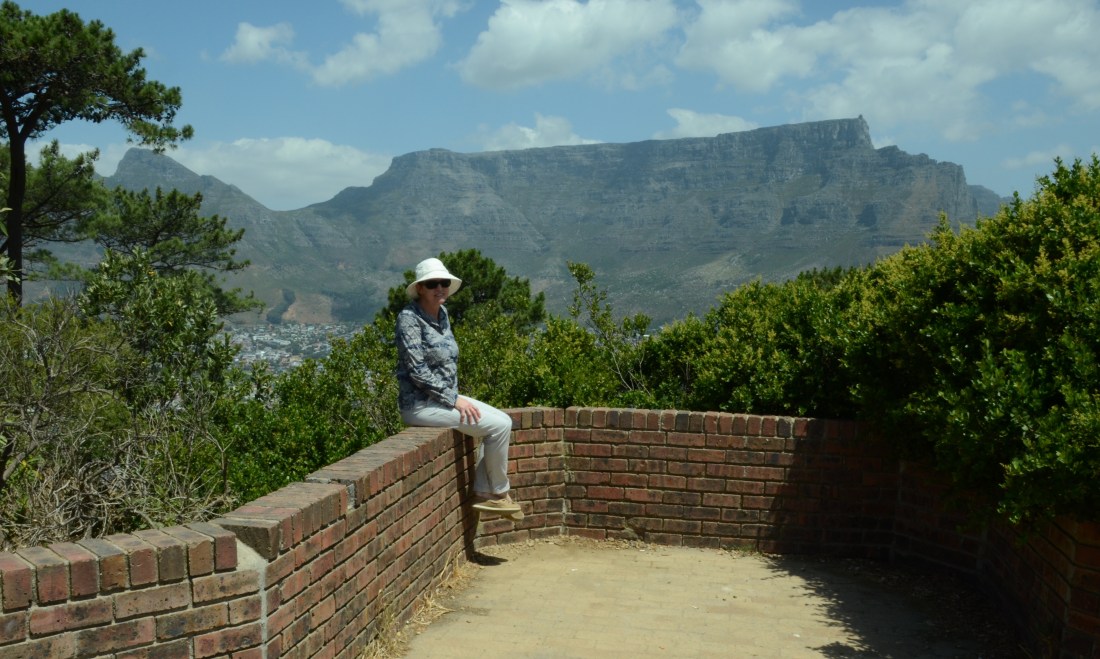
We decided to start our Saturday with a bit of grocery shopping. Our jet-set lifestyle knows no boundaries. We bought food for two breakfasts and two dinners for the princely sum of £8. With that task completed, we drove up to the cable car station on Table Mountain but were deterred by the queues. As an alternative, we decided to drive up Signal Hill from which we had splendid views of Table Mountain and of Cape Town laid out below us.

DSC_0121

There was also an enterprising group of young men offering tandem paragliding jumps and no shortage of people willing to rely on their skills and throw themselves off the hill. Neither Ishbel nor I took them up on their offer.

Later in the day, we headed out to Kirstenbosch Botanical Gardens  which is a lovely place for a relaxed wander around and is clearly well utilised by locals as well as tourists.

Returning to our apartment, we encountered an interesting conundrum. The flat is in a one way street and the entrance was closed off because filming was taking place in the cross street. We decided to go around to the top end of the street to see if we could reverse down to our parking garage. Luckily, the top end of the street was manned and we were allowed to drive down the wrong way since we were residents. It appears that they are filming a marathon scene, but we have no idea of what the context is.

Penguins and The Point

Friday was our first full day in South Africa and we decided to head out of town for the day. Our particular target was to see the colony of African Penguins that nest at Boulders Beach near Simon’s Town about 45km down the coast. After a false start in trying to find the right road to get there, we improvised slightly and took the much slower, but very interesting, coast road. This took us through towns like Fish Hoek and Kalk Bay, which was South Africa’s first resort town back in the 1860s.

After getting to Simon’s Town, we found the Penguin Centre very easily. African Penguins are on the red endangered list so access to the colony is controlled, with the area accessed through a turnstile pay point and along a couple of boardwalks to either side of the little bay they are in. You can get very close to the colony and they seem fairly untroubled by the humans milling around on the boardwalks above them. Ishbel took the photo at the top of the page, which gives an idea of how close you can get.

Having made it this far, why not drive the extra 25km to Cape Point, just south of the Cape of Good Hope, where you can see two oceans collide. We did that, and were very glad we did. As you drive down the road, there are several signs warning that baboons may be on the road, and advising that they are wild and dangerous animals that should not be approached, and definitely not fed. We didn’t see a single baboon all the way down.

The Point itself is part of a National Park, so we paid our entrance fee – ZAR 303, or about £17 each – and drove down to what seemed like the end of the earth.  There is a funicular railway that runs up and down to the lighthouse, but we decided to walk up since it was such a beautiful day, and maybe we would see baboons. It was a long climb, and no baboons appeared.

IMG_0101

Ishbel gets another photo credit here as she took this panoramic shot looking north back along the peninsula with ocean either side.

We decided to take the funicular back down to avoid the toll on the knees from the steps. I was pretty thirsty by this time but when we got down we found that the shop and restaurant had closed early for stocktaking and there were no drinks to be had. What we did find, however, was that the baboons were out in force wandering around the restaurant and car park searching for scraps left by previous diners. We had ticked that box so headed back to Cape Town by the more direct route.

We dined at Charango Barbecoa, just around the corner from our apartment where I had a 200g fillet steak for ZAR 200, about £11. Ishbel had lamb ribs for the same price. Eating out in Cape Town is not expensive.

After a long day, we settled back in the apartment to relax and have an early night. At around 10:30pm, we heard a brass band playing somewhere close by and decided we would investigate. Having been warned repeatedly about the dangers of Cape Town at night, we left any valuables at home and went out to see what was going on. There was a huge march just one block over from us and people were carrying lanterns with 1834 written on them. From our visit to the Slave Lodge on our first day, I remembered that December 1st was emancipation day for slaves. We asked one of the marchers if emancipation was what was being celebrated and that was indeed the occasion. We followed along for a few blocks enjoying the festive atmosphere before heading back to the apartment for the night. It’s always nice to stumble upon things like that.